
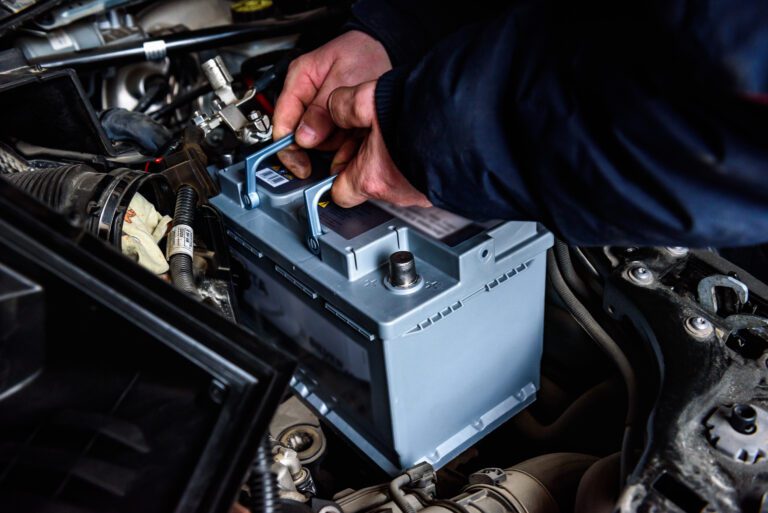
Choosing the right battery type and using the right testers and chargers can make a real difference to your operations. It affects your fleet vehicle’s cranking amps, charge acceptance, cycle life, diagnostic accuracy and long-term reliability.
A standard flooded battery, an EFB, an AGM, and a GEL battery may all be lead-acid batteries, but they don’t charge, discharge, age or fail in the same ways. So, before you test, charge, replace or register a battery for a 12-volt or 24-volt vehicle, make sure you know what type it is.
Here’s a simple breakdown of the main battery types you’re likely to see in the workshop.
Standard flooded batteries (FLA)
Standard flooded batteries are the traditional lead-acid batteries used in many older vehicles. They’re also sometimes known as FLA batteries, or flooded lead-acid batteries. They contain a liquid electrolyte and lead plates inside the case.
These batteries are very simple, cost-effective and probably still the most widely available. They’re nothing fancy, but for vehicles with low electrical demand and standard SLI use, such as an older passenger car or a basic fleet vehicle, they do the job perfectly well.
The main issue is cycle life. Standard flooded batteries don’t cope well with repeated discharging and recharging. They also have lower charge acceptance than more advanced battery types.
As such, they’re poorly suited to vehicles with start-stop systems, high electrical loads or that do lots of short journeys.
EFB batteries
EFB stands for enhanced flooded battery. An EFB is still a flooded lead-acid battery, but it’s basically an upgraded version, built to perform better than a standard flooded battery.
EFB technology usually includes improved plate design, stronger active material, better separators, and carbon additives.
EFB batteries offer better cycle life than standard flooded batteries. They’re designed to handle more frequent engine starts and deeper discharge events by accepting charge more quickly, which makes them common in entry-level start-stop vehicles.
While an EFB is an upgrade from standard lead-acid, it isn’t as robust as an AGM when it comes to higher electrical loads or more advanced energy management systems. And if the vehicle in question is a standard car without start-stop, an EFB is probably an unnecessary expense.
AGM batteries
AGM stands for absorbent glass mat. In an AGM battery, the electrolyte is held in glass fibre separators instead of sitting freely as liquid. This makes them more stable, more resistant to vibration, and better suited to heavy cycling. They’re valve-regulated lead-acid (VRLA) batteries, which means they’re sealed under normal use but can release pressure through a safety valve if internal gas pressure gets too high. That lost moisture, however, can’t be replaced.
Their strong cyclic performance makes AGM batteries better suited to repeated discharge and recharge cycles compared with standard flooded and EFB units. They also offer even higher charge acceptance, strong cranking performance and good performance even under partial state of charge (SoC) conditions. They’re also sealed and spill-proof (under normal use and without damage, of course).
That’s why AGM batteries are widely used in higher-specification start-stop vehicles, vehicles with regenerative braking, and applications with large electrical loads such as infotainment systems, heated screens, and driver assistance systems.
They can also be well suited when used as a matched pair in a 24-volt system for fleets running refrigerator lorries, advanced telematics, and start-stop neighbourhood delivery routes.
The inevitable trade-off for this performance is cost. AGM batteries cost more than standard flooded and EFB batteries. They’re also very susceptible to overcharging, incorrect charging, or using the wrong battery support equipment, which is common, because older chargers weren’t designed for AGMs. As mentioned, you also can’t replace any lost moisture, because AGMs are sealed units.
Also, if the vehicle was designed for an AGM battery, it shouldn’t be replaced with a lower-specification battery, not even an EFB. You’ll most likely run into electrical issues and early failure.
Some modern vehicles also require battery registration after replacement. This is sometimes called battery coding. It updates the vehicle’s battery management system so it can correctly charge the new AGM battery.
GEL batteries
GEL batteries use a gelled electrolyte instead of liquid electrolyte. Like AGM batteries, they’re valve-regulated lead-acid (VRLA) batteries.
Like AGM batteries, GEL batteries are sealed and low-maintenance. They are far less common in standard passenger vehicles. However, GEL batteries are usually better for slow, steady deep-cycle use, while AGM batteries are usually better for high cranking power and modern vehicle electrical loads. This makes them useful in specialist deep-cycle applications, including mobility scooters, caravans, motorhomes, marine leisure systems, golf buggies, access platforms, floor cleaning machines and backup power units.
GEL batteries aren’t usually the best choice for high cranking demand. They also need careful charging. The wrong charging voltage can damage the battery and shorten its life. Unless your workshop maintains the specialist vehicles, systems or backup power equipment mentioned above, you likely won’t have much need for GEL batteries.
Lithium batteries
In automotive and transport applications, lithium technology is now best known in electric vehicles, hybrids, leisure batteries and specialist power systems. The rise of EVs has helped drive major development in lithium battery technology.
One of the most common 12-volt lithium battery chemistries is LiFePO4, which means lithium iron phosphate. A 12V LiFePO4 battery is usually made from four cells connected in series. Each cell is around 3.2V nominal, giving a total nominal voltage of around 12.8V. By comparison, a traditional 12V lead-acid battery uses six cells connected in series. Each cell is around 2.0V nominal, giving a 12V nominal battery, or around 12.6V when fully charged at rest.
Lithium batteries are lightweight and have high energy density. They’re great for fast charging, long cycle life and reliable performance when used correctly. Their lightness also means they’re useful in applications where saving weight, high cycle life or compact packaging matters.
A vehicle must be designed to use a lithium battery. You shouldn’t simply swap a standard flooded battery for a lithium unit, for example. Lithium batteries also need the correct battery management system, charging equipment and diagnostic processes. And they’re more expensive and can be damaged if charged or used incorrectly.
Why do you have to check the battery type before testing?
Battery testing is about much more than connecting a tester and reading a result. Crucially, the tester needs to know what type of battery it is measuring.
That’s because flooded, EFB, AGM, lithium and GEL batteries each have different internal behaviours. Sure, there are similarities, especially between standard flooded and EFB, but each can show different conductance, internal resistance, reserve capacity and SoC patterns.
- A standard flooded battery has free liquid electrolyte and basic lead-acid plate construction. The tester uses this as the normal flooded baseline for conductance, internal resistance, CCA, SoC, and state of health (SoH) readings.
- An EFB battery is still flooded, but it has stronger plates, better separators and improved active material. The tester must account for its higher charge acceptance and better cycling ability, rather than judging it like a basic FLA battery.
- An AGM battery holds electrolyte in glass mat separators and usually has lower internal resistance. The tester must account for this when reading conductance, cranking ability, reserve capacity and overall battery health.
- A GEL battery holds electrolyte in a thick gel, which changes how it responds under load. The tester must account for its slower, deep-cycle-style behaviour instead of treating it like a standard starter battery.
- A lithium battery uses lithium-ion movement rather than a lead-acid reaction, usually with a battery management system. The tester must be set to the correct lithium battery type, voltage range and test algorithm for the reading to mean anything. You often need a dedicated 12-volt lithium battery tester.
If the technician selects the wrong battery type, the test result isn’t reliable. The tester is essentially running the wrong kind of test, using the wrong algorithm for that battery’s internal design and chemistry.
This could lead to unnecessary battery replacement, missed battery faults, increased downtime and higher VOR time.
Why do you have to check the battery type before charging?
The same principles apply to charging. In fact, it’s even more important to make sure you have the right charger, and that it’s set up for the battery type in question.
In a lead-acid battery, charging reverses what happened during discharge. When the battery discharges, lead sulphate builds up on the plates. When it charges, the charger pushes that chemical reaction back the other way. The lead sulphate turns back into active material, and the electrolyte moves back towards a fully charged state.
But different battery types react to charging in different ways. The various chemistries, plates, electrolytes, separators and internal resistances all affect how each battery type accepts charge.
- A standard flooded battery has free liquid electrolyte inside it. Its charge profile needs to carefully control voltage, especially near full charge. If the charger pushes too hard for too long, the battery can gas, heat up and lose water.
- An EFB battery is still a flooded battery, but it has stronger plates, better separators and improved active material. Its charge profile can support better charge acceptance than a basic flooded battery, but it still needs control to avoid excess gassing and heat.
- An AGM battery holds the electrolyte in glass mat separators. This keeps the electrolyte tight against the plates, lowers internal resistance and helps the battery accept charge faster. Its charge profile allows higher charge acceptance, but it still must control voltage closely. AGM batteries are sealed, so they’re less forgiving if the charger pushes too hard. If they vent gas from overcharging, that lost moisture usually can’t be replaced.
- A GEL battery holds the electrolyte in a thick gel. Its charge profile usually needs to be slower and more controlled. Too much voltage can create gas pockets in the gel and reduce internal reaction efficiency.
- A lithium battery is different again. Instead of a lead-acid reaction, lithium ions move between the electrodes. Its charge profile uses different voltage limits and must work with a battery management system to control cell balance, temperature, overcharge and over-discharge protection. You usually need a dedicated or specialist 12V lithium battery charger.
A charger must never be thought of as just ‘filling the battery up’. It’s carefully controlling an intricate chemical reaction by adjusting voltage and current outputs. If a technician selects the wrong battery type, or uses an inappropriate charger, it may use the wrong voltage, push too much current, stop too early, or hold the battery at the wrong stage. That can lead to heat, gassing, poor recovery, internal damage, early battery failure, or, in extreme cases, a thermal event.
Choosing the right battery type
So, which battery type should you choose for your fleet vehicle? The answer is usually straightforward: whichever the manufacturer recommends.
In general, upgrading a standard flooded battery to an EFB or AGM is usually possible, provided the battery is suitable for the vehicle and charging system. However, do you need to?
That’s a question only you can answer. Based on your previous testing data, could upgrading the battery lead to better service? Or would it be an unnecessary expense, with better results coming from more careful battery maintenance?
Keep careful records of all your battery test and charge results. We recommend ROBIS, which stores your records in the cloud and gives you easy access to battery data, trends, and analysis. It’s also affordable and scalable to your business needs.
Otherwise, as a simple rule:
- Standard flooded batteries suit older, lower-demand vehicles.
- EFB batteries suit many basic start-stop vehicles.
- AGM batteries suit higher-demand start-stop vehicles and advanced electrical systems.
- GEL batteries suit some specialist and deep-cycle applications.
- Lithium batteries suit specialist applications where the system is designed for lithium technology.
But the safest approach is always to check the original battery type, vehicle specification and manufacturer guidance before replacing, testing or charging.
Professional battery testing and charging equipment
Here at Rotronics, we supply professional battery testing, charging and diagnostic equipment for fleets, workshops, roadside teams and technicians working in the automotive, marine and specialist vehicle sectors.
We hope this page has given you a better understanding of what each battery type is useful for and when to use it. If you have any questions, or you need a tailored testing and charging setup for multiple battery types in your workshop, please get in touch by calling us on 01453 621244 or sending an email to info@rotronicsbms.com.

