
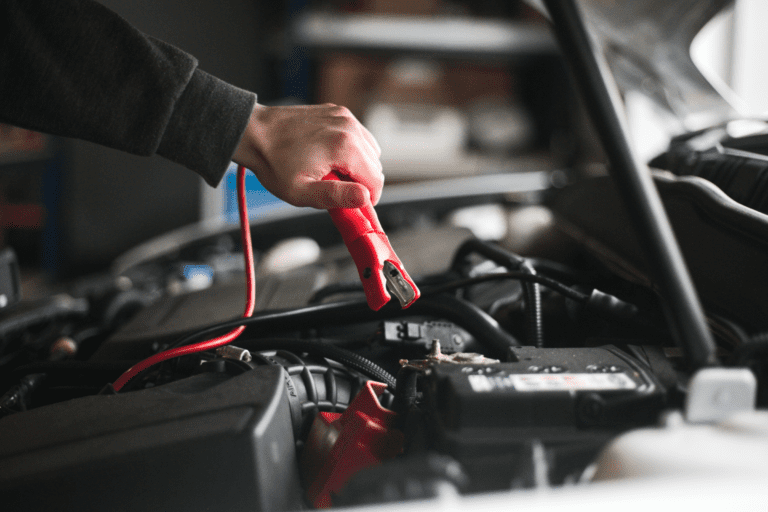
Fast charging is convenient. If your fleet truck or van needs a quick turnaround or to get started on the side of the road, a rapid top-up gets it moving again. Wonderful. But are there hidden costs?
These days, the topic of fast charging is quite widely discussed. And people often talk about it with a degree of alarm.
Does it negatively impact a battery’s state of health (SoH)?
Should you avoid fast charging altogether?
Does it even make a difference?
This blog addresses everything you need to know about fast charging 12-volt and 24-volt batteries, not the high-voltage traction battery packs found in EVs.
How fast charging affects battery chemistry
Fast charging is great, but only if you do it used sparingly. Because it’s actually a very high-stress event.
During fast charging, the battery plates are forced to accept a large current quickly. Under normal charging conditions, this is a smooth process. The ions flow at a controlled rate, which allows the battery to convert electrical energy efficiently into stored chemical energy.
When the charge rate is pushed high, however, the excessive current accelerates gassing, which causes water loss and leads to uneven chemical reactions across the plates. These effects can gradually wear down the positive plates through corrosion, which, in turn, can shed the active material and reduce the battery’s effective capacity. Over time, this can weaken the battery and reduce its ability to deliver full cold-cranking amps (CCA), making it less reliable when you need it most.
Heat buildup and structural stress
Manufacturers build batteries to accept a charge at controlled rates. When the current is high, as in fast charging, the battery heats up very quickly. Heat expands and stresses the plates and separators, and also accelerates chemical reactions inside the battery.
As the charging continues, elevated temperatures increase gassing and can accelerate the breakdown of the electrolyte through water loss, reducing its ability to conduct ions efficiently. Heat also amplifies mechanical stresses on the plates, which can contribute to swelling or, in extreme cases, leakage or internal damage.
Chargers with temperature compensation, staged charging and pulse desulphation help control stress. Rotronics recommends:
- The CTEK XS-7000 for a temperature-compensating 12-volt battery charger.
- The CTEK MXT 14 for a temperature-compensating 24-volt battery charger.
Balancing convenience and longevity
Over repeated fast-charging cycles, the battery gradually loses its SoH. As its total capacity declines, it struggles to deliver high currents and becomes more prone to issues such as swelling, venting or electrolyte loss.
Fast charging, then, is a trade-off. Although you gain the convenience of recharging the battery quickly, it comes at the cost of accelerated internal wear. And while it’s true that fleet operations demand speed, the truth is that there’s a better way. A way to manage battery life without relying too heavily on fast chargers.
Instead, take the time to develop a charging schedule. You need a controlled mix of regular charging, monitoring and load testing. Although you should tailor this to your workflows and operations, consider a weekly test and a bi-monthly load test on each of your batteries in your fleet. When your tests identify a struggling battery, use off-peak hours to charge it with a trusted battery charger.
Of course, this isn’t to say that the occasional fast charge is likely to be damaging. You shouldn’t stress any battery too much with a one-off fast charge. If you do find subsequent problems, the unit likely had significant underlying issues beforehand anyway.
Work with Rotronics for a better way
Here at Rotronics, we supply fleet operations like yours with reliable battery testers and chargers. Our fantastic range of products comes with a well-deserved, industry-leading reputation, helping your team identify issues in your batteries and implement cost-effective solutions, without resorting to damaging fast chargers.
Plus, with our online portal, ROBIS, you’ll be able to synchronise all applicable devices for immediate test results uploads to the cloud. These highlight trends in SoH, charge levels and more and can automatically help you schedule regular maintenance.
For more information about what we provide here at Rotronics, please don’t hesitate to get in touch. We’d be delighted to explain more about what we do and how our tailored approach has helped previous clients cut their non-starts almost entirely.

