
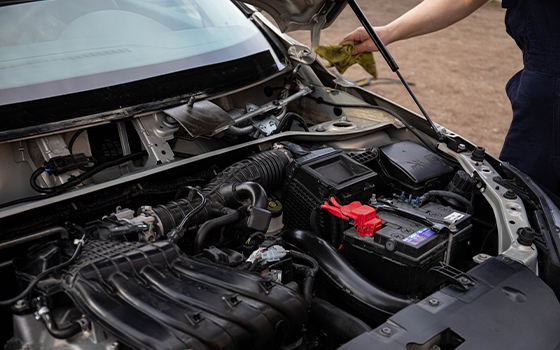
You pull a van into the workshop, and the battery reads flat. It hasn’t moved for months, and nobody has started it in weeks.
You have two options. The first is to buy a new battery, swap it out and get the vehicle back on the road. The second option is to try and reactivate it.
As experts in battery maintenance and testing, Rotronics is here to tell you that while reactivating a flat battery is possible, the answer isn’t always straightforward, and it’s very much a case-by-case question. We’d always encourage proactive maintenance over salvaging dying batteries. A dying/dead battery will show up with a ‘replace battery’ decision on Midtronics testers.
Why batteries go ‘flat’
The most likely time your team will encounter flat batteries in your fleet operations is after seasonal downtime, vehicle repossessions or the storage of rarely used vehicles. Of course, you’ll also encounter some during your regular operations, batteries that have far outlived their ‘potential’.
A battery goes ‘flat’ or dormant (that is, it reaches a state of being fully discharged) when the chemical reactions inside it slow down over time. That means it has less charge available when you need it, like when you turn the key in the ignition.
When they aren’t used for some time, lead-acid batteries develop sulphation. This is where lead sulphate crystals form on the plates, reducing the surface area available to react with the electrolyte.
AGM and EFB batteries are less prone to severe sulphation than lead-acid types, particularly AGM-types because their chemistry and makeup means finer, more uniform sulphate deposits. Similarly, EFBs are often more likely to recover better from deep discharges than standard lead-acid batteries.
The situation is usually worse if a battery has been regularly partially discharged. Partial charges create uneven layers of chemical activity across the plates. This imbalance can make reactivating a fully discharged battery more difficult.
You can usually reactivate most lead-acid, AGM, or EFB batteries if they only have mild sulphation.
It’s also important, in some cases, to investigate why a battery discharged. Sometimes, there’s a deeper underlying electrical issue with the vehicle, such as a parasitic drain. Try measuring vehicle current draw before attempting to reactivate it.
How to reactivate a dead battery
The first step is inspection. Have your team inspect for physical damage, such as dents, swollen areas, cracks or blown seams. Have them watch for areas of corrosion, especially around the terminals, or electrolyte leakage. If there are any signs of damage, don’t even attempt to reactivate it. It won’t work well and, more importantly, it’s dangerous. Safety comes first.
However, in the absence of any damage, you can proceed with the next step. For the vast majority of 12-volt automotive batteries (lead-acid, AGM and EFB), you need to connect the unit to a controlled charging cycle from a reliable charger.
Use a professional charger capable of delivering low current and temperature-compensated voltage, such as the CTEK Pro 120. Gradual charging encourages ions to move back into the active material and dissolves mild sulphation on the plates.
Some more advanced models come with desulphation modes. These use pulse technology to break down crystal formation on the plates and further improve the battery’s capacity.
Throughout the entire process, your technicians should closely monitor the battery. There are plenty of things to keep an eye on, but in particular, you need to be sure about temperature and voltage.
CTEK and Midtronics units come with temperature and voltage monitoring and will throw up an error light if they go outside set parameters. If you notice random spikes or troughs in either of these readings, it’s a sign that reactivation has either failed or that the battery is unsafe. Either way, it’s time to call it quits and turn instead to a replacement unit.
But if that all goes well, attach the reactivated battery to your battery tester and conduct a thorough analysis of how it performs under load. You might find the battery fails here, unfortunately, even if it seemed to perform well otherwise. If everything looks good, it should be good to go.
Signs of success and when to replace
The early signs of successfully reactivating a flat battery come when the voltage rises and the internal resistance decreases steadily. You should also notice the battery holding its charge if it’s left to rest for a period.
However, if you fail to recover any capacity within a controlled environment, the battery has likely suffered irreversible damage. Don’t let your technicians carry on trying to reactivate it. It wastes time and risks safety, so immediately switch to buying a new battery and replacing the old one. After that, it’s the usual deal. Dispose of the battery in accordance with your local laws, and all’s well that ends well.
As the fleet manager, you’ll be weighing the potential savings against replacement costs and technician labour hours. In some cases, you’ll simply decide that replacement is more cost-effective. It often is. While you might save your organisation a few quid by reactivating a seemingly dead battery instead of buying a new one, the technician’s time or the urgency of getting the vehicle back in service might well be worth more than that anyway.
And finally, even if your technicians successfully reactivate a battery, monitor it extra closely over the next few weeks. There’s an obviously increased risk of thermal issues or early failure under load, particularly for AGM or EFB type batteries.
Sometimes, reactivated batteries exhibit unusual characteristics due to internal damage, such as rapid self-discharge or loss of capacity. Test these units as often as feasible, and log the results in a battery management system, like ROBIS, to track any trends.
Where Rotronics comes in
Here at Rotronics, we develop and distribute industry-leading automotive battery testers and chargers. We work with fleets all around the country, from bus services to fire engines, and city council vehicles to taxis. Our range of professional battery chargers and testers helps your technicians keep track of how all the batteries that come through your workshop are performing and when to replace them.
That’s where ROBIS comes in. The ROBIS software logs results and highlights batteries that show early signs of dormancy, allowing you to attempt an early, safe reactivation process or a timely replacement.
Contact us today to learn more about our testers, chargers, and how to integrate battery reactivation and monitoring into your fleet management workflow.

