
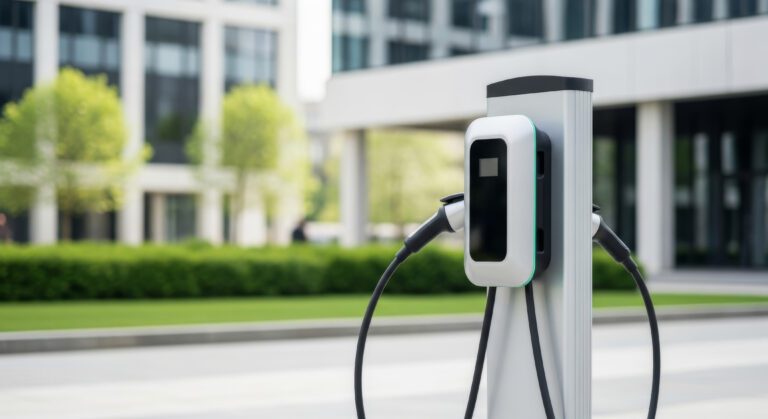
The EV revolution is upon us. Just 15 years ago, the Nissan Leaf and the early Tesla models were the only real mainstream electric vehicles. Now, they’re everywhere.
If you’re a fleet operation that relies on EVs as company cars, we know how much ‘range anxiety’ factors into your decisions. Thankfully, fast charging is now an option, so you don’t have to wait overnight for your batteries to replenish.
However, people have many valid concerns about this approach. Surely fast charging is bad for electric cars?
Well, the answer is more nuanced than a simple yes or no. On this page, we’ll explain why, and the best charging approaches you should take.
First, how does normal Level 2 EV charging work?
The primary difference is that fast charging utilises direct current (DC) instead of the alternating current (AC) commonly found in homes and most commercial settings.
An EV’s onboard battery uses DC, because that’s how batteries store energy.
When someone charges an EV using a Level 1 or Level 2 charger (plug-in or home charger), the power first passes through the car’s onboard charger. This converts AC to DC before feeding it into the battery.
The conversion in the car’s onboard charger limits the current flow, especially if it doesn’t support high kW. In turn, that means a slower charging process.
How does fast charging work in electric cars?
DC fast chargers, otherwise known as DCFCs or Level 3 chargers, use direct current. There’s no need to convert anything from AC to charge the battery.
Because there’s no need for the current type conversion, DC fast chargers bypass the car’s onboard charger entirely.
Instead, DCFCs send controlled, high-current DC straight to the battery pack. All the while, the fast charger and the car’s battery management system (BMS) exchange data over a digital protocol (like CHAdeMO, CCS, or GB/T).
The BMS monitors individual cell voltages, pack temperature and current in real time. If any cell approaches a voltage or temperature limit, the BMS instructs the charger to reduce current. This prevents overvoltage, overcurrent or thermal runaway. The charger then adjusts its output within a few milliseconds to stay within limits.
What happens during EV fast charging?
How long the process of fast charging takes really depends on your car’s battery pack size, its BMS, and other manufacturer-designed systems. In most cases, a car will charge from 20% to 80% in around half an hour (plus or minus ten minutes).
During the charging process, each cell in the EV’s battery pack operates within a defined voltage window. This is typically between approximately 3.0 and 4.2 volts per cell, depending on the chemistry.
The EV’s battery pack contains hundreds of cells connected in series and parallel, so the total pack voltage typically ranges from 350 to 800 volts. Fast charging increases current flow into the cells while holding voltage near the upper safe limit.
So, in theory, fast charging makes a lot of sense. You’re bypassing the conversion process, which loses some energy. But, of course, it’s not all quite that simple.
Negative impacts of regular electric car fast charging
Those high charge currents may not need converting from AC, but they still produce Joule heating in the cell’s internal resistance.
That heat, if not dissipated by the vehicle’s liquid-cooled thermal system, raises the temperature inside the cell too high. A high temperature means there are more side reactions, which slowly break down the electrolyte and active material on the electrodes. Over time, that leads to capacity loss.
Fast charging also means higher ion transport and stronger lithium concentration across the electrodes. That stress also contributes to reduced cycle life (i.e., lower range), especially if your drivers frequently charge their cars at low temperatures or to 100% state of charge.
Does that mean fast charging is bad for electric cars?
For occasional fast charging, the impact is small. For heavy, repeated fast charging (as in, multiple times per day), you might start noticing the degradation within a couple of years.
So no, fast charging isn’t particularly bad for most electric cars. It has a slightly more negative impact on your EV’s battery pack than regular Level 2 charging, but it’s only slightly noticeable over the course of years of use.
Fortunately, the problems discussed previously don’t make batteries stop working immediately. They accumulate very slowly, over hundreds or thousands of cycles.
So, if you want to fast charge your EV, go ahead. The benefits of being able to get your cars back on the road quickly outweigh the minor extra stress you put on the battery system.
The trick is to concentrate on controlled fast charging. That is, only fast charge when you (or your driver) need to. If the car won’t be required for eight hours or more, use a Level 2 charger instead. This keeps the risk manageable. Also, note that multiple short fast charges in a day may stress the pack more than one long fast charge followed by standard charging overnight.
How to keep your electric car batteries in top condition
Even using Level 2 chargers, your batteries will slowly degrade over time, as with any mechanical or chemical part. Good charging discipline will maximise how long your battery operates in peak condition, but it can’t delay the inevitable.
Once your drivers start noticing problems with an EV’s performance, it might be time to balance your battery modules. That’s usually your BMS’s job, but after years of use, things will inevitably need a little TLC.
Electric car module balancing can sound complex. After all, a battery is made up of hundreds of cells. How on earth can you balance them all at the same time without removing the pack?
Well, there’s good news, and it comes in the form of the Midtronics xMB-9640.
How to use the Midtronics xMB-9640 to balance EV modules
Where EV module balancing might have previously felt inaccessible to most workshops and garages, tools like the Midtronics xMB-9640 make it an ordinary, routine task. Your technicians still need up-to-date EV safety training and PPE, of course.
The xMB-9640 isn’t a simple plug and play device like a CTEK charger. It’s a specialist tool that requires at least Level 2 EV training to operate. However, it’s still an easy-to-operate, professional tool that enables in-house work, so you won’t need to visit the dealership for battery maintenance every time (apart from any warranty-related aspects, of course).
Your electric cars’ batteries and individual modules shouldn’t need regular rebalancing. If they do, there’s a deeper problem going on somewhere.
How to know when to rebalance EV modules
It’s time to rebalance your modules when it starts to impact the vehicle’s performance.
Here are a few signs to watch out for. Treat these as potential red flags rather than hard rules, knowing that the problem could be something other than module imbalance:
- State-of-health (SOH) spread between modules ≥ 5 %
- Module internal resistance variance ≥ 8-10% relative to pack mean
- Temperature rise rate > 1 °C/min during charge
- Temperature gradient (within pack) > 5 °C sustained for > 10 minutes
How to manage fast charging in fleet operations
In fleet operations, data is your friend. The more data you have to hand, the clearer the picture of what’s going on.
Whether your fleet uses fast chargers on site or your drivers use public ones, having access to charging data is useful. DC fast chargers log key metrics like current, voltage, energy delivered and session time.
Now, as a fleet operator, you might be able to access this data using the charging network’s software or platform. If the charger is connected to the vehicle’s BMS or telematics system, you may also be able to view overall battery pack information like state of charge and pack temperature.
However, for in-depth analysis, you still need to schedule regular battery pack servicing and balancing.
As well as the xMB-9640, which specialises in module balancing, you could investigate the Midtronics GRX 5100, which is tailored to entire pack balancing.
The GRX 5100 is a great option when you need pack-level diagnostics that cover all modules plus communication (CAN/LIN), and you want a flexible tool for many service jobs.
Take control of your electric car fast charging with Rotronics
So, the moral of the story is that fast charging does come with a couple of slightly more negative side effects. But the benefits of charging your car quickly far outweigh them.
Here at Rotronics, we’ve made it our mission to help businesses like yours stay on top of your battery maintenance. With our range of EV testers and chargers, including for the 12-volt auxiliary system, we’re invested in your success.
So, if you run a fleet operation or a commercial garage, and you’re looking to enhance and improve your EV service and maintenance options, why not give us a call? We’ll be happy to answer any questions you might have about any of our products, and explain how they’ve made such a difference to other organisations around the UK.

