
Your fleet EVs rely on their high-voltage propulsion batteries. They are, quite literally, the driving force.
Despite onboard battery management systems (BMSs) helping keep the cells balanced, the cells themselves inevitably degrade over time. On this page, we explain what exactly happens to make your fleet electric cars’ batteries imbalanced, what happens when you balance them and how to do it.
What cell balancing means
In an EV, cell balancing refers to bringing individual cells (or cell groups) to the same voltage. This helps the battery operate efficiently and maintain its usable range. Let’s define a few key terms here:
- Voltage is the electrical potential of a cell at a given moment. In Lithium-Ion cells, voltage roughly reflects the amount of stored energy.
- State of charge (or SoC, as it’s usually abbreviated) is the percentage of usable energy remaining in a cell. The BMS estimates the SoC using voltage, current flow, coulomb counting, temperature and model-based estimation.
- Capacity, measured in amp-hours (Ah), is the total amount of charge a cell can store. Cells naturally lose capacity as they age.
- Internal resistance is the resistance to current flow inside a cell. As internal resistance increases, the cell generates more heat and experiences a larger voltage drop under load, which can cause it to reach its voltage limits sooner than other cells in the pack.
So, although voltage and SoC are related, they aren’t the same. For example, a 4.2V cell may have 100% SoC at 4.2V. But if it drops to 3.7V, the SoC may have dropped to between 40% and 60%. And if the cell voltage drops to 3.0V, the cell is approaching its minimum safe operating voltage. It still contains energy, but to prevent damage to the cell, the vehicle’s BMS prevents it from discharging any further.
By cell balancing, you aim to bring all cells (or cell groups) within a module to the same voltage.
Why EV cells become imbalanced
The specific battery pack makeup depends on the brand of your fleet EVs. However, in most cases, manufacturers arrange cells in parallel circuits to form a cell group. The cell groups are arranged into modules in series, and the modules are connected in series to form the overall battery pack.
Cells within a parallel group rarely become significantly imbalanced because parallel connections naturally equalise their voltage. Current is shared between the cells, which helps keep them at similar states of charge.
However, cell groups within a series string begin to differ in voltage and SoC from each other. This is because the cells within each group come with microscopic differences in their chemical composition. Over time, the stress of charge and discharge cycles, load differences, varying temperatures, and general age-related deterioration means some cell groups develop higher internal resistance and, thus, lower capacity. As such, they reach their voltage limit sooner, meaning they store less usable energy than the other groups. At the same time, the BMS must reduce or stop charging the pack. It can’t risk those reduced-capacity cells overcharging, which could lead to thermal runaway (fire).
The resulting cell imbalance means the battery pack can no longer reach its full usable capacity, and those weaker cell groups also cause the battery to reach its low SoC limit sooner. The battery pack is only as powerful as its weakest cell group.
The relation to capacity and internal resistance
Even if the capacity and internal resistance seem okay, your fleet EV’s batteries are still imbalanced if the voltage delta is high and each cell group has a varying SoC.
Think of imbalance as a series of connected tanks. Standard imbalance, which occurs due to general wear and use, is just like having more in one tank than another. All you need to do is rebalance the levels. But when you have low capacity or high internal resistance, that’s like one of the tanks having shrunk. You can’t rebalance the levels then.
How modern BMS systems balance cells
Onboard BMSs typically use a process called passive balancing. This occurs in the later stages of the charging procedure.
The on-board charger supplies current to the battery pack, while the BMS monitors and controls the allowable charge rate.
Each cell group’s circuit is fitted with a resistor. When a cell group approaches its voltage limit, the BMS switches a resistor across it, dissipating a small amount of energy as heat.
This slightly reduces the net charging current into that cell group by creating a bypass path, allowing the other cell groups to ‘catch up’.
As the charging process gets the overall pack closer to 100%, the resistors in more cell groups activate.
Eventually, the car finishes charging, having used passive balancing to ensure every cell group reaches a similar voltage and approximate SoC.
Some battery systems use a more advanced method called active balancing. It uses clever technology to actively redistribute energy between certain modules or cell groups, and is already used in some consumer electronics. Theoretically, this should allow for more accurate balancing and less wasted energy. However, it’s still rare in mainstream EV battery packs, and hasn’t yet been fitted to any mainstream electric vehicle (except in hybrid or limited test cases).
When balancing won’t fix the problem
Just before we conclude, let’s mention when cell balancing won’t fix your EV’s battery problems. You now know how EV battery balancing works on an individual cell (or cell group) level. In most cases, the variations between cell groups that lead to different voltages and SoCs are minimal. But if they’re more severe, like those mentioned below, rebalancing won’t work. You’ll need to replace the affected module or battery pack section:
- Failing cells – if the cells are physically or chemically damaged, they can’t maintain the same voltage or state of charge as the cells around them. Balancing cannot repair this.
- High internal resistance – as Lithium-Ion cells age, chemical changes inside the battery increase internal resistance. This can be caused by electrolyte degradation, growth of the solid electrolyte interface (SEI) layer, Lithium plating, or general electrode ageing. These changes reduce the cell’s ability to deliver current and usually indicate permanent degradation rather than a simple balancing issue.
- Thermal damage – if a cell or cell group has overheated, this causes irreparable damage. Again, balancing won’t fix this.
How to diagnose cell imbalance
While there are many technical ways to diagnose EV cell imbalance, such as:
- A large voltage delta (the difference in voltage between the highest and lowest cell group);
- High internal resistance (indicating capacity loss or degradation, not just imbalance); or even
- Thermal imaging cameras to identify cells with high internal resistance.
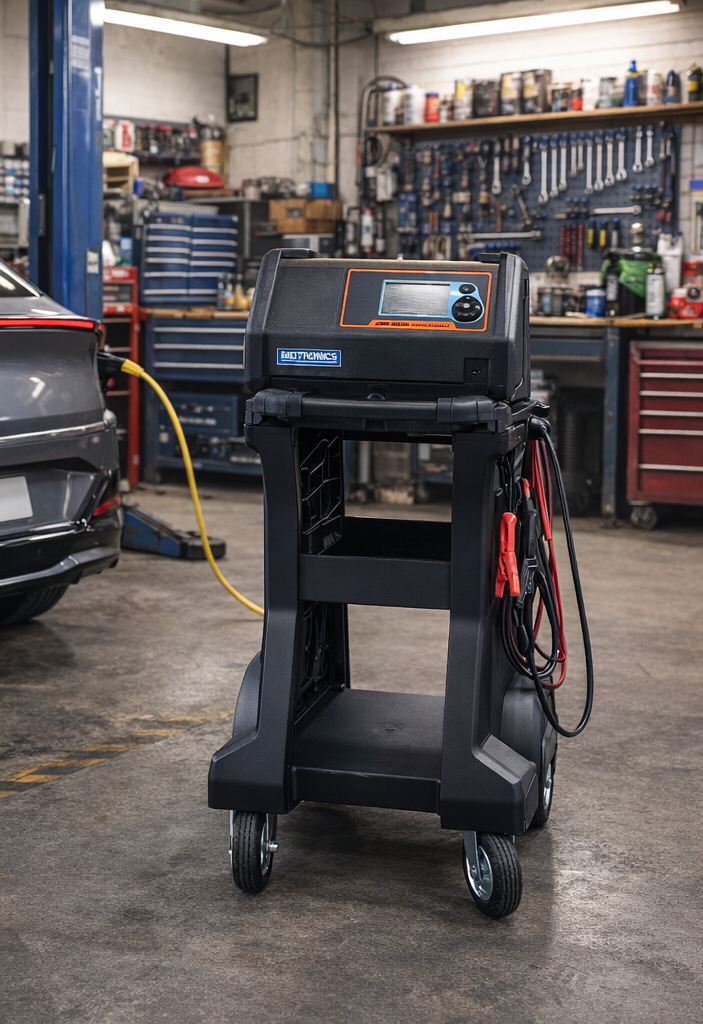
However, the simplest, by far, is to source a trusted EV cell balancing charger. We recommend the Midtronics xMB-9640. This unit isn’t just a tester; it also charges and balances your cell groups and modules.
Although your fleet EVs have on-board balancing (passive) from the BMS during charging, it’s more of a preventative solution, minimising the small voltage differences that naturally develop between cell groups over time.
That’s why you need to manually rebalance your EVs’ battery packs on a module or cell group level. You restore the vehicle’s performance and range while minimising the risk of future high-voltage battery problems. That is, provided you don’t have any damaged cells.
Because it operates at relatively high current, the xMB-9640 can equalise modules much faster than many general service tools. During this process, it also displays key diagnostic data such as cell voltage, temperature and voltage differences, making it easier to identify weak modules or abnormal behaviour within the pack.
You can source yours from Rotronics today. We hold specialist EV balancing equipment like the xMB-9640, as well as other battery testing and charging tools. Get in touch with our experts to develop a customised plan for how best to maintain your fleet of EVs, and learn how we’ve helped organisations all around the country maximise uptime and minimise breakdowns and non-starts.

