
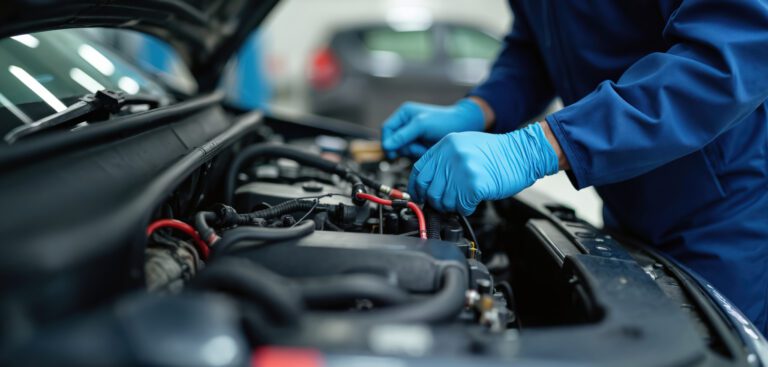
Roadside breakdowns aren’t just frustrating. They mean downtime, delayed schedules and disruption to your drivers, all of which can impact your bottom line and reputation.
While many fleet operators traditionally relied on third-party recovery services, a growing number now handle first-line roadside support themselves.
If you’re one of them, or are developing such a system, your mobile technicians must be properly equipped. An emergency mobile booster pack is the one thing their maintenance vans should contain as an absolute priority.
This guide outlines a practical, in-house approach to managing your fleet’s roadside breakdowns, with a focus on battery-related non-starts, one of the most common causes of callouts.
Why fleets handle breakdowns in-house
Small fleets may not need in-house mobile mechanics or tow trucks. However, for any fleet containing a larger number of cars, vans, buses or trucks, the external recovery costs can quickly add up, especially for relatively minor issues that you can resolve on-site within minutes. Setting up an in-house breakdown team allows you to:
- Reduce third-party callout fees
- Minimise vehicle downtime
- Maintain schedules
- Improve driver confidence and safety
- Control diagnostic standards
Depending on the size of your fleet, your technicians could work in your workshop, as usual, until they’re called out onto the road. Or you may find it more financially viable to invest in full-time mobile mechanics.
The most common fleet roadside failure
Modern vehicles are far more reliable than they once were. That’s a good thing. But they’re more reliable thanks to their complex electronics. And when those electrical systems malfunction, they can be difficult to diagnose and repair. Common roadside issues include:
- Starter battery failure
- Parasitic drain
- Alternator faults
- Loose or corroded terminals
- Vehicles left with ignition systems active
Battery strain is common in fleet vehicles. Your delivery vans might stop and start their engines hundreds of times per day. Refrigeration trucks need to run compressors and fans 24/7. And any vehicle fitted with auxiliary systems (such as telematics, CCTV, power units, etc) is likely to see its battery wear out sooner rather than later.
Thankfully, a flat battery is usually a quick fix, whether that means replacement or reconditioning back at your premises. The only challenge is getting the vehicle back to your workshop efficiently, minimising costs and getting the driver back on the road as soon as possible.
You don’t need to issue booster packs to every vehicle in your fleet. However, do make sure that each of your maintenance vans is equipped with one. Allowing for occasional clustering, two or three professional-grade units should be sufficient to cover your fleet, depending on its size. Mobile booster packs are common for:
- Bus and coach operators
- Local authority fleets
- Utility and infrastructure vehicles
- Delivery and logistics companies
- Plant and equipment fleets
What your fleet maintenance van should carry for battery problems
You know your business better than anyone else. You know what equipment your vans are most likely to need. As experts in battery technology, here’s what we recommend your mobile technicians carry for this particular issue:
- Professional-grade battery booster pack
- Diagnostic battery tester
- Multimeter
- Basic hand tools
A quick overview of using a booster pack
When responding to a battery-related breakdown, your mobile technician should:
- Position the support vehicle safely behind the stranded vehicle with hazards active.
- Conduct a quick visual inspection of the vehicle’s terminals and cables.
- Use a tester to confirm the battery’s condition.
- Connect the booster as usual:
- Positive to positive terminal
- Negative to negative terminal or approved grounding point
- Activate the booster unit.
- Start the vehicle.
- Disconnect the booster from the terminals in reverse order.
- Allow the vehicle to idle and verify that the charging system is working as it should.
As you’re aware, a successful boost won’t resolve the root cause of a non-start. So, have your driver or mechanic bring the vehicle back for diagnostics immediately, if possible, or at the earliest opportunity.
Why consumer booster packs aren’t suitable for fleets
Many booster packs marketed to the public are designed for very occasional use. They’re a relatively affordable backup unit that a driver carries in their own car. However, for servicing fleet vehicles, you’ll usually need a unit with:
- A higher peak current
- The capacity to run more cycles before recharge
- Faster recharge time
- Reverse polarity protection
- Rugged casing
- Reliable performance in cold conditions
As always, the downtime costs can far outweigh your investment in equipment. Using specialist equipment designed for fleets (rather than consumers) will help you avoid repeat battery failures, and frustrated technicians and drivers.
Professional mobile boosting solutions for fleet operators
If you run an in-house roadside breakdown team, the CTEK RB3000 or the RB4000 are the tools you need. These high-discharge lithium booster systems deliver 3,000A and 4,000A peak current, respectively. That’s plenty of cranking power for large-capacity petrol and diesel engines, even those with partially sulphated batteries or high parasitic loads.
Both the RB3000 and the RB4000 use internal protection circuitry to manage the risk of reverse polarity, short-circuits and voltage spikes. That’s a critical aspect of boosting modern vehicles with sensitive ECUs, CAN-bus networks or telematics hardware, protecting them from transient voltage events during connection or load application.
From an operational standpoint, both the RB3000 and the RB4000 perform reliably. They’re engineered for repeated deployment across multiple vehicles. You should get up to 30 or 45 assisted starts per charge. Of course, this depends on the engine size, ambient temperature and battery condition. It takes only 2.5 to 3.5 hours to fully recharge the emergency booster pack, ready for its next shift.
Additional outputs (USB-A and USB-C) allow the units to function as an auxiliary DC power source for diagnostic tools, tablets, phones or inspection equipment in the field. Your technicians also get an integrated torch as part of the unit, particularly useful during nighttime, winter or low-visibility roadside callouts.
Reducing vehicle downtime
Your mobile technicians will often be able to resolve a battery-related roadside non-start in under 15 minutes, provided they have the correct equipment available. Without it, your fleet may face:
- Third-party callout fees
- Missed service windows
- Driver delays
- Customer dissatisfaction
- Knock-on operational disruption
In other words, it pays to have trusted professional equipment like the CTEK RB3000 or RB4000 on board in your maintenance vans. These are mobile, high-current support tools designed to minimise downtime and the resultant costs.
For more information on our range of emergency mobile battery booster packs, get in touch with Rotronics’ team of battery experts today. We’re here to learn about how your operation works, so we can tailor the optimal solution to your needs.

