
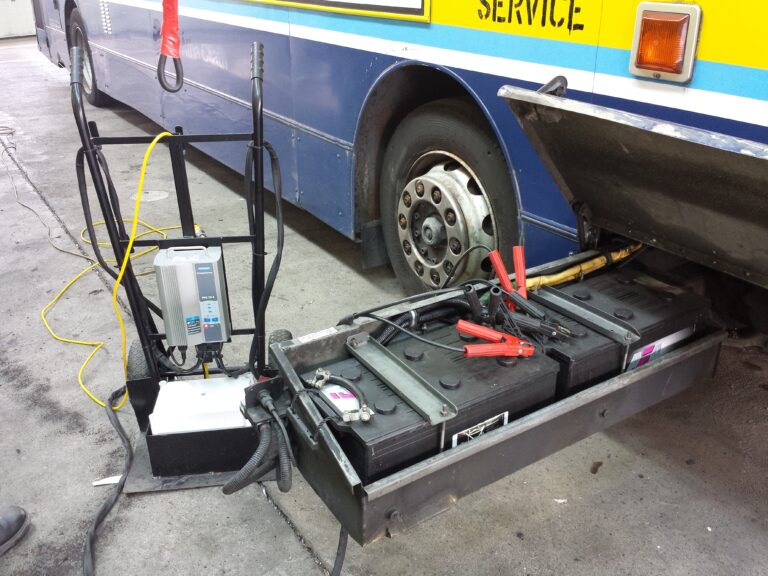
Battery imbalance can be a vehicle’s silent killer. It’s a natural process that quietly works away until one of the 12-volt batteries in your 24-volt system gives up before its time, often taking the other one down with it. Battery balancing is the key to stopping it.
Here at Rotronics, we’ve made batteries our business. We help fleet workshops and customer-facing garages all around the country optimise their vehicles’ electrical performance.
So, whether your workshop takes care of buses, coaches, HGVs, bin lorries, ambulances, fire appliances, military equipment or larger agricultural vehicles, battery balancing is an absolutely critical part of your process. Here’s what matters, what to look for, and how to act before your costs stack up.
Why new batteries don’t stay balanced
Of course, you’ll be familiar with setting up your vehicles’ 24-volt systems. Connect the two 12-volt batteries in series, and away we go. New or reconditioned batteries should be in good condition and sit at 12.72 volts when charged.
At this point, assuming the batteries have been well-charged and the vehicle doesn’t run (or have any parasitic drains), the system is balanced. That is, both batteries share the same state of health (SOH) and state of charge (SOC).
And if everything could stay that way, your battery systems would remain absolutely fine. Unfortunately, that’s not how it works in practice. As soon as the vehicle starts cycling – stop-start routes, night heaters, tail lifts, all the usual power draws – the problems start.
That’s because a 24-volt system is – and has to be – two 12-volt batteries in series. However, that means that the onboard charging system treats it as one 24-volt block. And as a result, if (and when) one battery starts lagging behind, the system won’t pick it up. As long as the overall charging voltage across the two in series is 28.8 Volts, the onboard system stays happy.
It doesn’t take long for the two batteries to diverge, especially with the workload demand of most 24-volt fleets. After three to six months, you’ll find that most batteries have started to diverge from each other. One begins to show signs of sulphation, while the other might start gassing from overcharging. In other words, the set is compromised, performance drops and you’ll need to replace them earlier than expected.
What happens when things go out of sync
Of course, the last thing you want is for those two 12-volt batteries to go out of sync, and here’s why.
In a perfectly balanced system, the ‘24-volt battery’ (that is, the two 12-volt units) gives consistent cranking power, supports the vehicle’s onboard systems and copes with deep cycling. Each one does an equal share of the work. But when they become imbalanced, the weakest battery dictates the performance of the set.
This creates a vicious cycle. The undercharged battery degrades faster because the alternator can’t recharge it as well. It can’t support load, especially in cold weather or under high electrical load. On the other hand, the overcharged battery continues to get pushed further beyond what it needs, leading to overheating, gassing and electrolyte loss. In some cases, we’ve seen thermal events, too.
The result is chaos, no matter the size of your fleet and workshop. Vehicles fail on the roadside. Breakdown recovery becomes more frequent. Passenger or client satisfaction drops. Replacement intervals tighten. Technician workload increases. Employee morale falls. In summary, overlooking 24-volt maintenance often leads to avoidably expensive costs.
Getting proactive with 24-volt battery balancing
As fleet technicians or fleet managers, you already know how to test batteries, and we’re not here to reinvent the wheel. But we’ve seen how much our clients have saved by implementing more in-depth 24-volt battery management systems, and we want to help you share in those successes.
Voltage is only part of the story. As a battery technician, the most crucial things to analyse are SOC to SOC and SOH to SOH. Unless these are equal, your two 12-volt units should be taken as imbalanced.
The key is regular, scheduled testing on an individual battery level. Otherwise, imbalances simply go unnoticed until the inevitable vehicle breakdowns. Use equipment that provides accurate, detailed diagnostic insight on each battery. Log the results using trusted software. This will help you track trends across your entire organisation and flag any deviations. For instance, you might notice a higher electrical load on certain routes or with certain vehicles.
Once you detect an imbalance, the next step is balance charging. Both batteries should be recharged separately but simultaneously to bring them back to a state of equalisation.
Why fleets trust Rotronics to help with battery balancing
That’s where we at Rotronics come in. With over 20 years of experience, we provide workshops and fleet teams with the tools, training and support needed to manage their vehicle batteries effectively. As the UK partner for leading brands like Midtronics and CTEK, we offer advanced diagnostic equipment combined with data-driven insights via our ROBIS Analytics portal.
And we aren’t just about supplying the kit and leaving you to get on with things. We work with you to understand your battery testing and balancing objectives and help you meet them, doing everything we can to help you reduce downtime and maximise operations.
It’s time to take control of your 24-volt battery maintenance. Get in touch with our team today to discover how we’ll help your fleet stay on the road longer and reduce your battery-related costs.

