
The odds are that the two 12-volt batteries in your 24-volt system came in pairs. A technician probably installed both on the same day. They’re likely the same brand, and they should be exactly the same spec. But by now, they’re very rarely in the same condition as each other.
Here’s what you’re almost certain to find. One battery will be undercharged, the other overcharged. The weaker one may have failed entirely. It may even have caused the other one to fail prematurely.
This is battery imbalance. And it often isn’t down to manufacturing faults or how the vehicle is driven. Unfortunately, it’s just part of everyday chemical and mechanical deterioration. And actively managing it is the only way to prevent imbalance from shortening the life of every battery in your 24-volt fleet.
A 24-volt system with a 12-volt problem
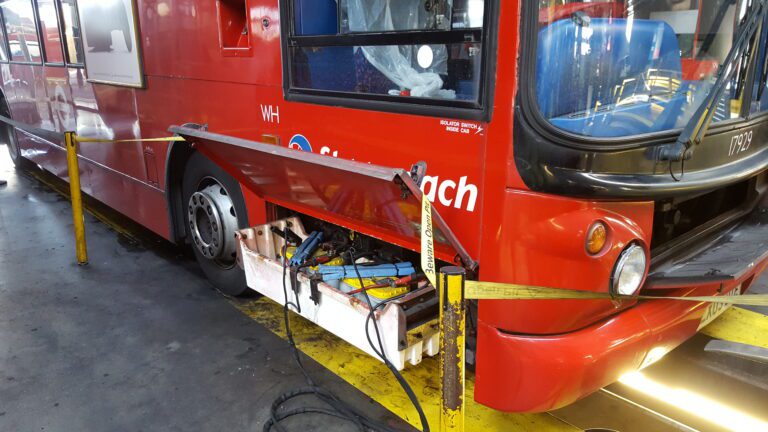
If you work in fleet maintenance, you already know the setup. Two 12-volt batteries wired in series give your commercial vehicle the 24 Volts it needs to handle higher cranking loads and electrical systems. That’s standard across most industries – HGVs, buses, fire appliances and so on.
But while the system is 24 Volts, the reality is that you’ve still got two independent 12-volt batteries doing the work. As we mentioned in the introduction, these batteries might appear virtually identical when they were new, each fully charged and working in sync. But within three to six months of service, those microscopic and invisible differences become more prominent, and the batteries fall out of balance.
This creates a slightly odd situation. The strength of the 24-volt system is its ability to pair two standard 12-volt batteries in series. But that same strength is also its biggest flaw.
Because connecting the batteries in series means that, as far as the onboard vehicle charging systems (that is, the alternator) are concerned, it’s one 24-volt battery. And provided the total charging voltage equals 28.8 Volts, it assumes everything’s fine. It simply can’t tell if, for example, one battery is reading 15 Volts and the other 13.8 Volts.
That means that if nobody’s checking them individually, the imbalance will only get worse until the vehicle fails to start.
What battery balancing really means for 24-volt fleets
Make battery balancing part of your routine maintenance. That’s by far and away the most important message from this article. It isn’t a special function or something to whip out when your vehicles suddenly start breaking down. Treat it as a maintenance step during your regular service. This means you catch problems far sooner and prevent them from becoming anything more unreliable – and more expensive.
It doesn’t take long at all. Here’s how to check and balance a 24-volt set:
- Use a reliable battery tester to test each 12-volt battery separately. Specifically, you’re looking at their state of health (SOH) and state of charge (SOC).
- Log the records and use previous results to identify undercharging, overcharging and deterioration.
- Charge the weaker 12-volt battery back to alignment.
That’s it. That’s all you need. A modest investment in a reliable battery tester and charger, and good access to reliable battery management software (such as ROBIS). Simply put, regular checks and preventative action keep things running smoothly.
The challenge is that most workshop technicians are checking only voltage. If the pair of 12-volt batteries delivers around 28.8 charging Volts, it passes. Unfortunately, as we’ve mentioned, that single value masks the imbalance. The overcharged battery compensates for the weak one, and the cycle continues until failure.
Battery balancing, then, is much more about workshop behaviour than any particular vehicle adjustment. Proactive beats reactive, every time.
The power of proactive battery balancing
It makes a massive difference when workshops test 24-volt systems regularly and keep on top of balancing. Over a year, we’ve seen clients cut battery replacements by up to 50%, reduce vehicle defects by 43%, and even an incredible 95% reduction in non-starts from Norfolk County Council.
The long and short of it is that balanced batteries last longer because they aren’t being pushed to (and held at) extremes. Alternators perform better because the two 12-volt units accept charge more evenly. Your technicians spend far less time chasing and diagnosing faults. Your drivers complain less. Your customers complain less. Your suppliers complain less. Workshop morale increases. Cost control goes up. What’s not to love?
And although we’ve already mentioned this, it’s worth saying again. Perhaps most importantly, battery balancing helps you turn maintenance from reactive to predictive. When you know which vehicles tend to drift, and when, you can schedule interventions that save money and keep your operation moving.
All the benefits of partnering with Rotronics
That’s where we at Rotronics come in. We’ve supported commercial vehicle fleets and workshops for over 20 years. We supply trusted diagnostic tools from Midtronics, CTEK and more, and we help teams use them properly. With our ROBIS Analytics portal, you get visibility across your entire fleet’s battery performance. Alerts, reports and trend tracking all help you make informed decisions about your battery maintenance activities. But more than that, we work with you. This isn’t just an off-the-shelf solution. We tailor it to your needs and will be by your side as you build a practical battery programme that includes testing, charging, balancing and data analysis, all so your team can take control of battery performance from the workshop floor.
If battery balancing isn’t part of your routine yet, now’s the time to start. It’s easy to introduce, simple to run and the results speak for themselves. Reach out to our friendly team today to see how we can help you build battery management into your everyday workshop routine.

