
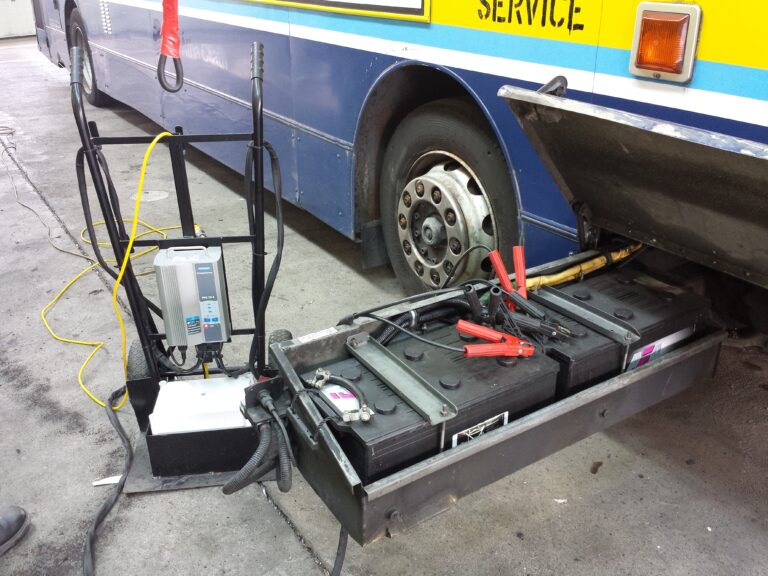
The 24-volt battery systems in your trucks, lorries, buses, coaches and other utility vehicles naturally feel harder to stay on top of than those in standard 12-volt vehicles.
With a 24-volt system, the vehicle can run normally until one morning, it won’t start. In many cases, the cause is an imbalance between the two 12-volt batteries, even though the overall system voltage still looks fine. It could, of course, also be something deeper in the electrical system.
Balancing 24-volt batteries remains one of the most overlooked checks in fleet maintenance. It’s also one of the easiest ways to reduce repeat failures. As such, here’s how to check if your vehicles’ batteries are balanced.
Why do batteries in 24-volt systems get unbalanced?
A 24-volt system relies on two 12-volt batteries wired in series. They share the same load and the same charging source. But in practice, they don’t age in the same way, even if they’re installed at the same time. This is thanks to things like:
- Slight differences in internal resistance
- Minor differences in plate condition
- Temperature variation across the chassis
- Uneven parasitic loads
These differences are unavoidable in the real world. Nobody can control molecular-level chemistry during the manufacturing process. Once installed and over time, these differences mean the batteries wear in different ways.
During discharge, the weaker battery reaches a lower state of charge (SoC) first, so even though the stronger one still has some charge to provide, the entire system’s voltage drops. During charging, the stronger battery reaches the target voltage first, so the charging process stops, even though the weaker battery hasn’t yet fully charged.
At first, these differences can be minor and barely noticeable. However, as time and miles pass, they get bigger. Eventually, you reach the point where the charging system can’t restore enough usable charge for reliable starting. That’s not a fault with the alternator, but rather the low charge acceptance (thanks to internal resistance) of one of the battery units.
Standard voltage checks across the full 24-volt system rarely catch this. The overall voltage may well be fine, because you’re taking the sum of the two units. Although one is high and the other low, the total looks normal. In reality, one is closer to the upper voltage limit, and the other likely undercharged.
How to check if your vehicles’ batteries are balanced
There’s no set rule for how quickly a 24-volt vehicle’s batteries become unbalanced. That’s because it all depends on the factors mentioned above, as well as the vehicle, the driver ,and the routes. However, if you use this vehicle every day, it’s likely somewhere within a few weeks to a few months that you’ll need to balance the batteries.
The best way to know is regular checks. You don’t need to remove either of the batteries to test them, and while testing them individually is better than trusting the overall voltage, performing a 24V battery test will give you better, more accurate results.
The EXP-1000 FHD can test each individual battery while connected to the vehicle. It has specific testing algorithms to determine individual battery health, 24V set performance and to see if the two batteries are balanced and working well together.
When testing, always measure the SoC, then run state of health (SoH) or conductance testing on each unit.
Minor differences are normal. As long as the results stay close, the batteries can be treated as balanced. However, if you start seeing larger gaps like the examples below, it’s worth balancing the batteries. We’ll explain how to do that in the next section.
- An open-circuit voltage difference of more than about 0.2V between the two batteries after rest (for example, 12.6V vs 12.4V).
- One battery reaching charge voltage much faster than the other during charging.
- Uneven cranking voltage drop when tested individually, even though total system voltage still looks acceptable.
The most accurate approach is to build up trends rather than relying on a single reading. Using software like ROBIS, you’ll be able to see how the batteries’ statistics change over time. This will give you a much better idea of when you need to restore SoC balance to your batteries.
What to do if your vehicles’ batteries are unbalanced
Your approach here depends on the state of health readings. If both batteries show acceptable SoH but uneven SoC, you should:
- Charge the batteries using a charger like the CX PRO 100-2, which can individually charge each battery, then balance them both.
- Let each battery complete the full charge cycle (absorption), not just the initial high-current (bulk) charge.
- Retest SoC and SoH before refitting. However, let the batteries rest after charging as you’ll get inaccurate results if you test straight away.
But if one battery shows reduced SoH:
- Try to recondition the battery, which may help in mild sulphation cases.
- The EXP-1000 has a battery pairing feature that will tell you if batteries are compatible, so you need only replace the failed one.
- Don’t pair an old battery (even if it’s the ‘stronger’ one) with a new one, unless it has a very high SoH. The imbalance will make the new battery deteriorate faster. Use a tester to determine SoH.
- Never use second-hand or pre-used batteries of any kind.
- Test both batteries individually before you install them.
- Record the installation dates and test results for both units.
After you balance or replace the batteries, continue to monitor them under your regular maintenance schedule. A quick battery test from a reliable tester should give you all the information you need. Namely, that’s state of charge and state of health, as well as things like cranking voltage and conductance test results.
Provided your technicians keep on top of this, you should see far fewer roadside breakdowns. In turn, that should lead to significant cost savings.
If 24-volt issues keep appearing in your fleet, it’s worth reviewing how batteries are tested, charged, paired and balanced. Rotronics supplies battery testers and chargers designed for fleet workshops like yours. With tried-and-tested brands, we’re sure we’ll have a unit that suits your setup. Get in touch to discuss the tools and processes that can help keep your vehicles starting and running all day long.

