
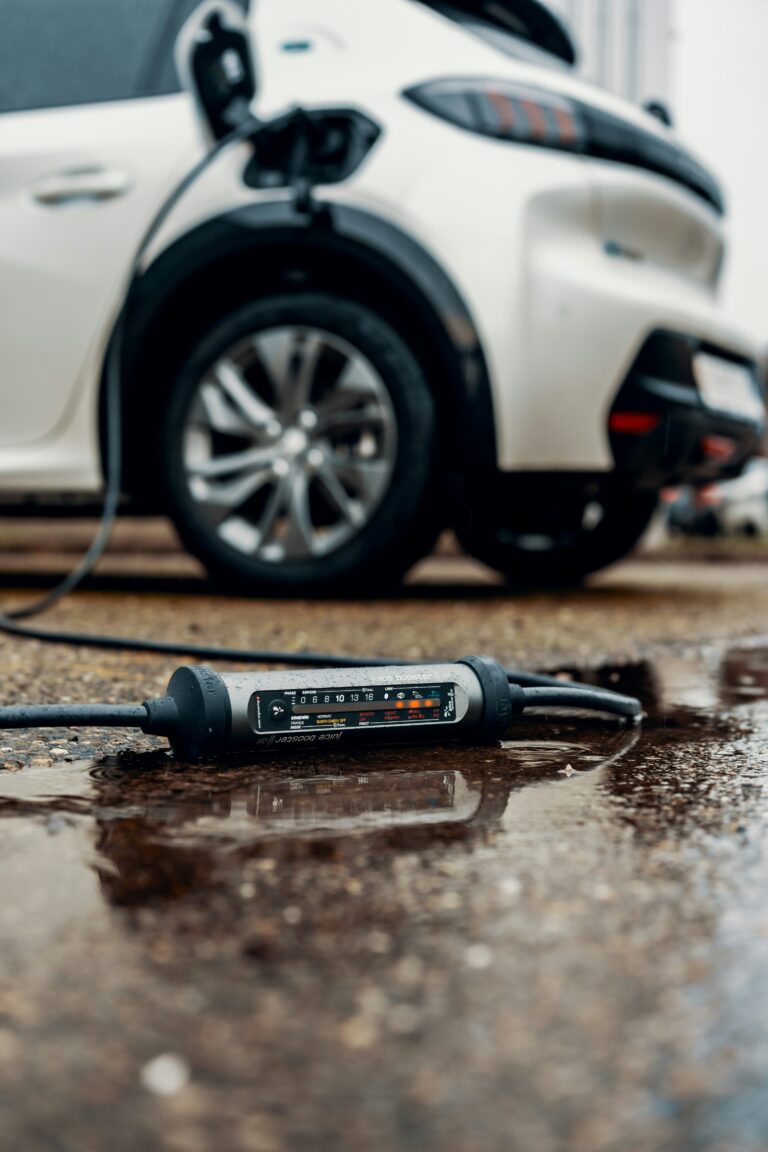
You know those mornings when there’s too much to do and you’re in a rush? Well, maybe that’s every morning. Between an emergency puncture repair and getting all your vehicles ready for the day, you might be tempted to fast charge that car battery to save some time.
But when you go back to it, the battery case feels a bit warmer than it probably should be. Does that mean that fast charging is unsafe?
As usual, the answer is nuanced. However, in general, fast charging a car battery is usually safe, provided you’re using the right, high-quality charger, and the battery’s in good condition.
On this page, we’ll break that all down further so you know exactly what’s going on.
What does fast charging actually do to a battery?
A standard lead-acid battery stores energy through chemical reactions. It has a lead negative plate and a lead dioxide positive plate, with sulphuric acid and water between them.
When the battery discharges, electrons leave the lead plate and flow through the vehicle’s wiring to the lead dioxide plate, creating current. Inside the battery, ions move through the electrolyte and both plates turn into lead sulphate.
When you recharge the battery, including fast charging, the process runs in reverse. Charging reverses the reaction, converting lead sulphate back into lead, lead dioxide and sulphuric acid.
Under a low charging current (for example, 2 amps), this is a fairly routine process. When you introduce fast charging (often between 15 and 30 amps), the chemical formula is still the same, but now you’re dealing with much more heat from the higher current. The heat means the battery generates more gas as the electrolyte gets hot, and the outer surfaces of the plates charge faster than the material deeper inside, so the battery looks charged, but isn’t.
Of course, that presents a problem. It’s also why a voltage test straight after fast charging will show high voltage, even though, in reality, it lacks usable charge. And although AGM and EFB batteries manage this heat better than conventional flooded batteries, they still struggle. For example, in AGM batteries, the heat accelerates grid corrosion and, over time, dries out the separators. They’re both also sensitive to the same overvoltage and heat.
This isn’t to say that fast charging is unsafe. It’s not dangerous by default. But uncontrolled fast charging on a regular basis certainly could be.
The best way to use fast charging is as a temporary, one-off measure when you’re in a rush. A fast-charged battery should be safe to fit to a fleet vehicle, but conduct some state of charge (SoC) and state of health (SoH) tests before you reconnect it, just to be on the safe side. The battery will need some low-current charging or dedicated reconditioning to return it to a high SoC. This should come from a modern, high-quality battery charger. If the SoH is still low after charging or reconditioning, it’s time to replace the battery.
The potential dangers of fast charging
As we’ve just touched on, fast charging itself isn’t dangerous. Misusing or overusing it is. Here are a few of the main dangers to watch out for.
Using an outdated, unregulated charger
Lots of workshops rely on older tech. And while those old chargers certainly have their strengths, regulating current certainly isn’t one of them.
Many older chargers were designed to deliver as much current as possible, and quickly. There will be some regulation, like a fixed current supply or a crude voltage limit, but it’s not enough for a modern fleet operation looking to cut down on failures and non-starts.
Old battery chargers might not taper the charge rate correctly as the battery reaches capacity. They might not adapt to temperature. They might not respond to rising internal resistance. This means the current stays too high for too long, amplifying all the problems discussed previously.
Using a faulty or damaged charger
A battery charger with internal (or even external) faults is a significant safety risk. It introduces unpredictable and potentially dangerous behaviour. Look out for things like inconsistent charge times, an abnormally warm battery case, or chargers cutting out long before the battery reaches a full state of charge.
Faults like these could include failed regulation circuits, damaged leads, poor terminal connections, missing switches, signs of overheating and more. They cause voltage spikes, unstable current delivery, false charge termination, and maybe even earthing problems. And, of course, it’s the battery that absorbs all this stress.
Using the wrong charger for the battery type
Make sure you match your charger (or your charger’s settings) to the right battery chemistry. Flooded lead-acid, EFB and AGM batteries all accept charge in slightly different ways. Each expects specific voltage limits and charging profiles. With modern fleet vehicles increasingly dependent on different battery chemistries, especially AGM-types for stop-start applications, using the right charger is non-negotiable. Using the wrong charger setting can lead to:
- Overvoltage in AGM batteries
- Excessive gassing in flooded batteries
- Incomplete charge in EFB systems
Trying to fast charge a failed or unstable battery
Battery problems may include physical damage such as dents, bulging or cracks in the case, electrolyte leaks, acid residue or burn marks on the exterior, heat damage, strong sulphur or solvent-like smells during charging, excessive heat build-up, or excessive or early gassing.
As soon as you notice any problems with a battery, dispose and recycle it. It’s no longer safe, and simply not worth your time or safety to try to fix. Trying to charge a faulty battery is dangerous, let alone fast charging it. A few of the main reasons for battery failure include:
- High internal resistance from sulphation
- Shorted or partially shorted cells
- Plate shedding and sediment build-up
- Electrolyte stratification
- Mechanical damage or case swelling
- Age and wear
When you have problems like these, the battery will build heat much quicker under fast charging. This leads to gassing, erratic voltage behaviour and, in extreme cases, pressure build-up inside the unit.
Fast charging may hide battery problems
Finally, fast charging becomes a risk when it’s used to mask underlying battery faults, rather than address poor SoH. When fast charging, a battery with high internal resistance reaches its charge voltage quickly.
This makes the charger reduce its charging current. Although it thinks its work is done, the battery isn’t actually holding a good SoC. And when you put it under load, the voltage will collapse, leading to a roadside non-start.
The danger comes from repeating this process over and again, which wastes time and resources. For instance, a technician may check battery voltage straight after fast charging. The reading will often look normal because surface charge pushes the voltage up. In reality, the battery may still have high internal resistance and limited usable capacity, which only shows up once the battery is put under load.
All this highlights the importance of a dedicated SoC and SoH battery tester, backed up by a modern and controlled charger.
So, is it safe?
Fast charging is safe when the charger and the battery are in good condition, and when you match the charging profile to the battery chemistry.
But if any of the potentially unsafe things above apply, including the warm battery mentioned in the introduction, it’s better to spend your time and energy upgrading your charging equipment.
Here at Rotronics, we supply battery chargers and testers for fleets and garages. We know the sorts of problems you run into. That’s why our range of professional fleet battery chargers includes models with built-in SoC and SoH testing, as well as safe, regulated fast charging options.
If fast charging has become a daily habit in your workshop, it may be time to review the tools and the process behind it. Get in touch with Rotronics to discuss what you need, and we’ll help you find it.

