
A 24-volt battery system offers fantastic benefits. It halves current for a given power level, reducing resistive losses and improving cranking performance in high-load vehicles.
But one of the main operational challenges in these setups is battery imbalance. These issues tend to develop over months or even years, and the driver and technicians might not notice anything wrong. Then, one time, there simply isn’t enough power to start the engine.
So, why does that happen? Well, battery imbalance is an unavoidable part of 24-volt maintenance. On this page, we explain why vehicle batteries drop out of balance, and what to do about it.
Why do batteries in a 24-volt vehicle go out of balance?
A 24-volt system uses two 12-volt batteries in series. In most 24-volt vehicles, the alternator and voltage regulator control only the total system voltage. They do not actively monitor or balance the state of charge (SoC) or internal resistance of each 12-volt battery. Independent monitoring is technically possible with additional hardware, such as aftermarket battery equalisers. Nevertheless, all this is where vehicle batteries start to drop out of balance.
Microscopic differences between batteries during production
Not even the world’s most well-known manufacturers can build perfectly similar batteries on a molecular level. From the factory, there will be small differences between batteries, even those next to each other on the production line.
These differences exist on a chemical and molecular level, completely invisible to the naked eye. Even initial testing is unlikely to spot the differences. They’re that small. They include the following:
- internal resistance
- plate condition
- electrolyte concentration and stratification risk in flooded types
Differences after the batteries are installed in the vehicle
Once you connect the two 12-volt batteries to your vehicle to power the 24-volt system, you introduce even more changes, including:
- terminal resistance
- cable resistance
- uneven temperatures across the chassis
- parasitic drains
All these differences , in both the batteries and their place under the bonnet, slowly change how each battery charges and discharges over time.
How the two batteries charge and discharge differently over time
During discharge, the current flows through both batteries in series. The weaker battery reaches low SoC first, and it shows a faster voltage drop under load due to higher internal resistance. For a time, the combined 24-volt reading remains high enough for normal vehicle operation because the stronger battery offsets the voltage drop. Meanwhile, the weaker unit is repeatedly driven into deeper discharge cycles.
During onboard charging, the same imbalance works in reverse. The battery with lower internal resistance reaches the regulator’s voltage setpoint first. Because the charging system monitors total system voltage, charge current is reduced or terminated at that point, leaving the weaker battery undercharged.
As this cycle repeats, the weaker unit spends more time at partial and progressively lower SoC. When a battery remains at a low state of charge, the rate of sulphation on the plates increases. This increases internal resistance, which in turn causes the battery to reach charge voltage earlier during charging and suffer a larger voltage drop under load. And thus, the cycle continues.
How to rebalance batteries for a 24-volt system
Rebalancing means restoring each of the 12-volt batteries to the same SoC (within reason). It also means confirming each unit’s state of health (SoH), so you don’t push a failed unit back into service. Here’s what to do:
Test each battery
Disconnect the series link. Test each 12-volt battery on its own. You’re looking for SoC and SoH readings, which give a far more accurate picture than voltage alone.
The best thing to use here is a conductance tester like the Midtronics CPX-900. Conductance testers apply a small AC signal and measure the battery’s response to estimate internal resistance and SoH.
Charge each battery individually
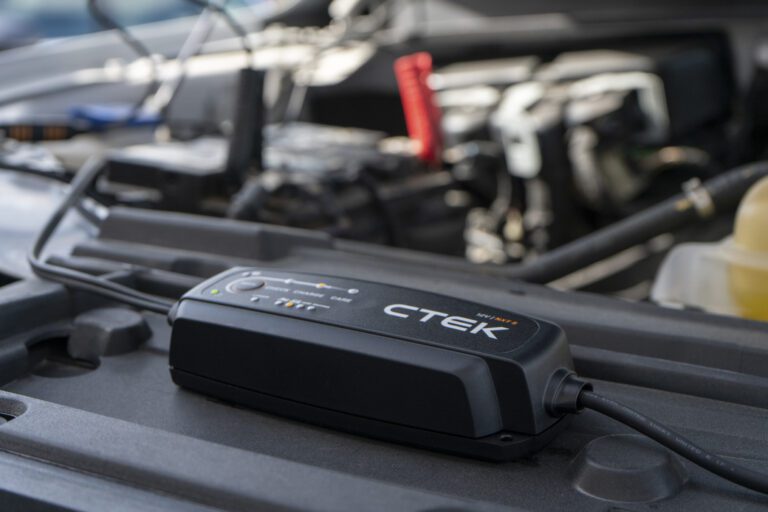
Charge each battery individually as a 12-volt unit. Make sure you use the correct battery type setting (flooded, EFB, AGM). Let the charger complete both the bulk and absorption phases. Only stop when the charger signals it’s finished.
If either of the batteries returned a poor state of health reading, a mild recovery/reconditioning mode may help with mild sulphation cases. However, note that while SoC returns with charging, low SoH is often irreversible. If the recovery mode doesn’t work, the best way forward is replacing both batteries.
Retest after charging
After you finish the charging process, retest the SoC and SoH on each battery.
However, it’s important to let the batteries rest a while after charging, first. If you test straight away, there will be surface charge resulting in inaccurate test results.
You need both batteries to have approximately the same SoC and SoH as each other. If SoH remains low on one or both of the units, the rebalance won’t work. The batteries will go out of balance again. As noted above, the best way forward is replacing both batteries.
However, if everything looks good, reconnect the batteries to your vehicle and do a final load test.
If you immediately run into battery imbalance problems again after balancing, there may be a deeper electrical issue somewhere in your system. Use diagnostic software and, if this fails, consider calling a specialist automotive electrician.
Replace as a matched pair when SoH diverges
When you need to replace the batteries thanks to poor SoH, fit a matched pair. Do not pair a new battery with an old one unless the older unit tests very high on SoH and remains stable over repeat tests. If you need to replace the whole set, the EXP-1000 FHD has a feature called Generate Pair. This checks if two batteries can be used together.
Source your battery tester and charger from Rotronics
As the UK partner for Midtronics and CTEK devices, we’re perfectly positioned to help you. Here at Rotronics, we help your fleet workshop develop a tailored battery management system to meet your business needs, workflows and budget. This can include chargers, testers, software tracking, technical support, and training. Whatever you need, we can help provide it.
So, if your fleet consistently sees repeat no-starts in its 24-volt vehicles, you don’t have to stand by and do nothing. There are plenty of ways to get ahead of this – and all on a much lower budget than you might imagine. For instance, after we helped Gloucester Fire & Rescue get started with ROBIS, it paid for itself in just six months.
If you’re looking for a new charger, tester, or to get involved with the many benefits of ROBIS, why not get in touch with us today? We’re always delighted to hear from businesses, small or large, and we promise a commitment-free chat where we learn about your needs and offer tailored solutions.

