
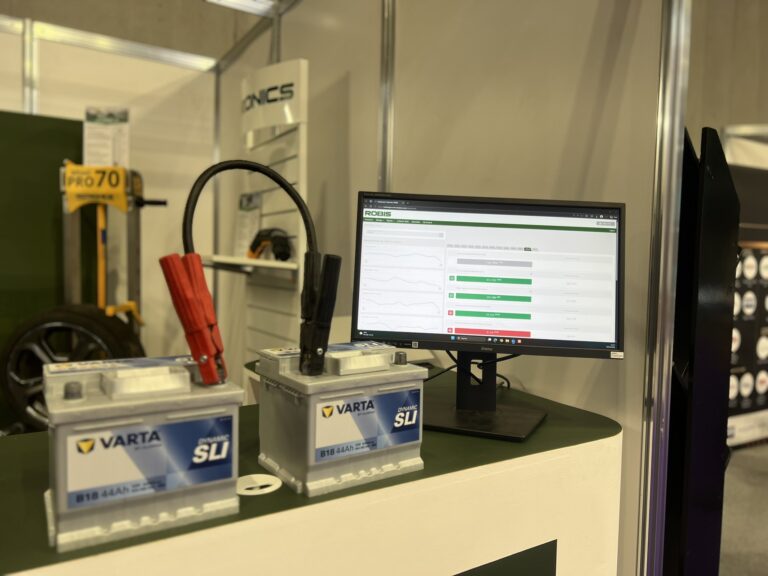
Does your car, van or truck depot already test batteries on a regular basis?
Yes? Good.
But how does it track and compile the results of those battery tests over time?
A battery test alone gives you a snapshot. It tells you what’s happening right then, but not how the battery’s performance has changed over the past months.
As such, a battery test alone doesn’t show whether your batteries are slowly degrading throughout your fleet. It doesn’t show why the same vehicle keeps coming back with the same issue. And it doesn’t show whether everyone in your depot is following the testing process correctly.
And so, even if you carry out battery testing every day, you could still be missing the bigger picture.
As experts in battery testing technology, Rotronics has a solution, ROBIS Analytics. But first, here’s what you need to know about not tracking your test results.
A battery test alone only tells you so much
A single battery test is very useful. Even alone, it puts you well ahead of competitors who do no testing whatsoever. But it is quite limited.
It can confirm SoH (state of health), voltage, conductance, cranking amps, internal resistance and so on. But your technicians don’t see any trend data. As such, they won’t notice the speed with which the battery is deteriorating, unless they have outstanding memories.
Why does that matter? Because your fleet depot is a busy place. It’s not just about keeping track of one vehicle. You have dozens, perhaps hundreds. Some of your vehicles may repeatedly see weak battery performance. Others may be consistently strong. The only way to know this, and to rectify the problem, is by tracking your battery test results.
Without a system to track those results, all that becomes harder to see. You’re left with isolated test events that mean essentially nothing, instead of usable maintenance data. And if some technicians in your workshop aren’t carrying out tests to the same standard, there’s no way of knowing that either.
The hidden costs of not tracking battery data
We discuss our solution, ROBIS Analytics, in the next section. Let’s take a moment now, though, to pinpoint the actual costs of not tracking battery test data. There are more cost implications than you might think:
- Unexpected breakdowns: A vehicle may pass one test, then fail in service later. The warning signs could have been picked up by tracking your battery test results.
- More vehicle downtime: When a battery-related failure takes a vehicle out of action, it disrupts your schedule, affects availability and puts more pressure on your depot.
- Higher workshop workload: When a battery suddenly fails, the workshop has to deal with it under greater pressure, perhaps including overtime. That often means unplanned repair costs, reactive maintenance and frustration from your team.
- Unnecessary battery replacement: If you have no clear history of your battery test results, you’ll likely err on the side of caution and replace batteries unnecessarily during services and repairs. Sometimes that works. But sometimes, the battery wasn’t the root cause of the problem, which means the expenditure wasn’t necessary, and may need to be repeated.
- More labour: Without data, diagnosis takes longer. Your technicians spend longer conducting diagnostics, looking for old results printouts, retesting batteries and trying to piece together what’s happening.
- Duplicated work: When your battery testing records are spread out across paper, local devices or spreadsheets, or don’t exist at all, your teams either can’t find or don’t trust the data. As such, they’ll probably have to repeat the tests.
- Less confident diagnosis: Without tracking your results over time, it’s harder to distinguish a degrading battery from a one-off reading or a separate electrical fault.
- Poorer process control: It’s much harder to keep track of whether your team members are testing batteries properly, consistently and at the right intervals.
How ROBIS Analytics turns fleet battery test results into action
In short, poor visibility of your battery testing data leads to poor maintenance decisions, which usually cost money. Thankfully, there’s a cost-effective solution. This is where ROBIS Analytics comes in.
It’s a comprehensive yet affordable piece of software for tracking fleet battery test results over time.
So, instead of looking at one result at a time, or keeping a filing cabinet full of indistinguishable test printouts, you can review battery performance across your entire operation from one place. You can see trends, repeat issues, weak assets, team member-related anomalies, and overall performance.
With the improved visibility provided by ROBIS Analytics, your depot can intervene much earlier. As soon as a trend is identified, you can act on it by testing or replacing the battery, bringing the vehicle in for further diagnostics, or whatever the situation calls for.
Don’t risk not having ROBIS Analytics
The point of battery test tracking software, like ROBIS Analytics, isn’t to create more admin. In fact, ROBIS can reduce your admin, compared with other systems.
Without ROBIS, you risk losing valuable insight into your operations, which can lead to much higher costs and failure rates.
Don’t take the risk. ROBIS Analytics is simple to integrate into your depot’s workflow. Compatible battery testers can even automatically upload results to ROBIS. Get in touch with our team here at Rotronics to find out more about ROBIS and what it can do for your depot, and to get a quote.

