
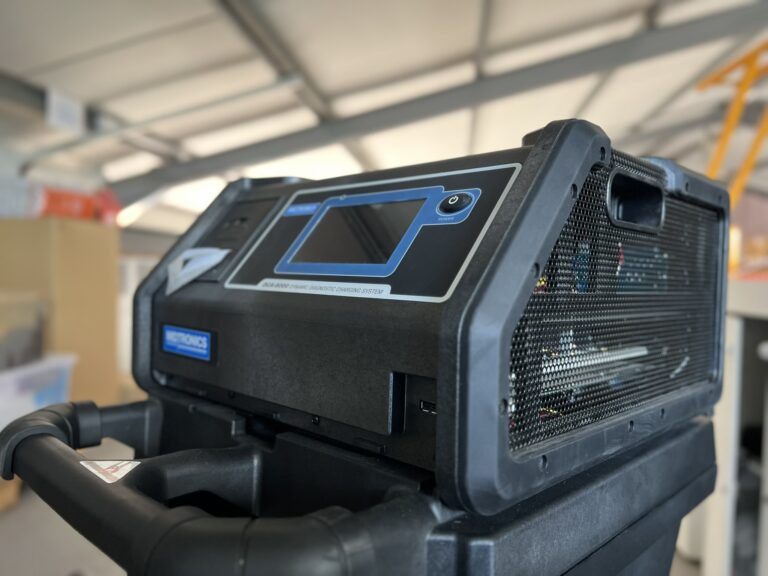
If you run a busy garage, service centre or workshop, there are only two things on your mind, speed and accuracy.
You need fast answers and solutions that minimise repeat faults.
Using the wrong battery charger can slow your workflow down. The right one can speed everything up.
Midtronics makes a wide range of excellent battery chargers and testers. Two of the most comprehensive and well-known are the GRX-3000 and the DCA-8000.
But which is better?
Well, the truth is, they’re designed for different jobs. The GRX-3000 is a charging station with testing capabilities, whereas the DCA-8000 is a diagnostic system that also charges. This guide explains which one is right for minimising breakdowns and non-starts, and why.
What is the Midtronics GRX-3000 designed for?
The Midtronics GRX-3000 is now obsolete, but it was built for frequent, structured workshop use. It’s an ideal tool for a mechanic in a service lane or an inspection bay, where speed is important. It offers the following features:
- Controlled current up to about 50 A
- Manual voltage and current settings
- Common rating system (SAE, EN, DIN, JIS) support
- Compatible with flooded lead-acid, gel, EFB, and AGM chemistries
In simple terms, it’s perfect for routine battery servicing, but not for complex diagnostics.
When to use the GRX-3000 vs the DCA-8000
Use the GRX-3000 when your goal is consistent, reliable maintenance, when you have high vehicle throughput, and when you’re bound to a tight schedule. You should pick the GRX-3000 if you want:
- fewer diagnostics but still a reliable charging station
- repeatable service-lane workflow
- controlled battery maintenance
What is the Midtronics DCA-8000 designed for?
The Midtronics DCA-8000 goes into more diagnostic depth than the GRX-3000, which also makes it an indispensable tool for your service bays. It’s excellent for scheduled battery maintenance and for identifying recurring underlying faults. And because it tests while charging, the DCA-8000 can often determine battery condition much faster than traditional test-then-charge workflows. It offers the following features:
- Multi-stage battery analysis
- Conductance, resistance, and charge acceptance monitoring features
- Load condition simulations
- Clear decision outputs
- Controlled current up to about 70 A
- Compatible with flooded lead-acid, gel, EFB, AGM, LiFePO4 and lithium chemistries
When to use the DCA-8000 vs the GRX-3000
Use the DCA-8000 when your goal is an in-depth understanding of your batteries. It’s best for service centres that deal with vehicles with heavy electrical loads, such as emergency vehicles, utility and field-service vans, or delivery trucks. You should pick the DCA-8000 if you want:
- the deepest diagnostics
- the fastest pass/fail decisions
- the best tool for fault-finding
GRX-3000 vs DCA-8000: side-by-side
- Primary role:
- GRX-3000: charging station
- DCA-8000: diagnostic charger
- Max current:
- GRX-3000: ~50 A
- DCA-8000: ~70 A
- Diagnostics:
- GRX-3000: basic integrated testing
- DCA-8000: advanced multi-stage diagnostics
- Best use:
- GRX-3000: routine service
- DCA-8000: routine servicing and fault finding
- Programming stability:
- GRX-3000: capable but not optimised
- DCA-8000: designed for stable module programming support
- Decision output:
- GRX-3000: technician interprets results
- DCA-8000: automatic pass/fail verdicts
- Workflow:
- GRX-3000: test then charge
- DCA-8000: test while charging
Best way to implement a battery charger in your workshop
So, which is best? The GRX-3000 or the DCA-8000?
If you don’t have too many vehicles to service, we suggest the DCA-8000. It gives more in-depth results and means less downtime.
If the most important thing is throughput, getting through a significant number of services per day, the GRX-3000 is a perfectly acceptable alternative if you already have one. Unfortunately, it’s no longer available to buy. So, it’s best to have a DCA-8000 on-hand for when you need it.
That’s where Rotronics comes in. We stock industry-leading battery chargers and testers from manufacturers like Midtronics. We’re dependable, resourceful and bring a vast wealth of experience. Work with us to benefit from tailored advice and help with developing a custom battery management system to fit your company’s operations.
For more information on our products, or to discuss more about what you need, reach out to us by calling 01453 621 244 or emailing info@rotronicsbms.com. We look forward to hearing from you.

