
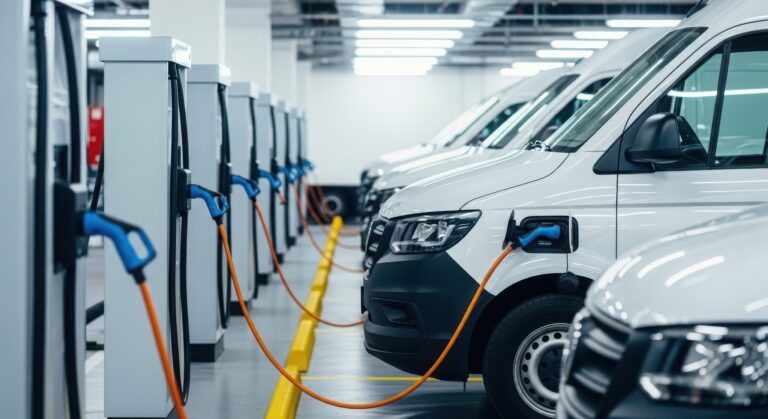
If your taxi or delivery fleet relies on battery electric vehicles (BEVs), you’ll know the pain of unexpected charging. The last thing you need is for the office to hit a scheduling or range problem. Now, it falls on you and your workshop team to find the cause and stop it from happening again.
Over time and with heavy use, a traction battery will lose some capacity. However, differences in charge between the cell groups in the battery can also reduce the vehicle’s usable charge.
Balancing reduces differences in state of charge (SoC) between cell groups, helping the pack make better use of its stored energy. At Rotronics, we help fleet workshops choose tailored equipment for that work. The first step is finding out whether balancing will address the fault.
Check for EV battery cell imbalance
There’s no need to treat removing the pack and rebalancing the modules as routine jobs for every EV. Instead, use complaints about range, charging changes and battery warnings to decide when to diagnose any problems.
You might also find cell group imbalance during a routine service. At this point, check the diagnostic trouble codes (DTCs) and live battery data. Compare the cell group voltages at rest, during charging and under load, following the manufacturer’s test procedure.
The difference between the highest and lowest cell group readings is called the cell delta. It’s expressed in millivolts. Record the pack’s SoC, temperature and current alongside it. These are important. Without them, comparing future readings can be misleading.
Check voltage-sense wiring, connections and cooling faults, too. A reported low cell voltage can come from a sensing fault or connection problem.
How battery chemistry affects voltage readings
Lithium iron phosphate, or LFP, is used in many EVs. With LFP, a cell’s voltage changes very little across much of its charge range. Two cells can therefore show nearly the same voltage while having different states of charge. A small cell delta alone doesn’t prove that they’re balanced.
You’ll also come across nickel manganese cobalt (NMC) and nickel cobalt aluminium (NCA) batteries. With these, the voltage changes more as the charge level rises or falls. A reading taken at rest can therefore tell you more about their SoC.
Use the onboard battery management system’s (BMS) charge estimates to help interpret the voltage readings.
How passive battery balancing works
In most EV packs, the BMS uses passive balancing. It switches a bleed resistor across selected higher-charge cell groups, releasing energy as heat. This reduces the net current entering those groups during charging, allowing the remaining groups to continue charging. The BMS controls the pack’s charge current to keep cell voltages within limits.
Follow the OEM’s recommended charging or servicing routine so the battery reaches the conditions needed for passive balancing. A blanket instruction to charge every fleet EV to 100% won’t necessarily suit every pack.
Passive balancing can take quite some time. As an illustration, correcting a 1Ah difference at a continuous 100mA bleed current would take around ten hours. Pauses and operating limits could extend that even further. So, schedule the manufacturer’s balancing routine overnight or during a quieter period, allowing enough time for the BMS to complete it.
Balancing replacement EV battery modules
If a cell group is worn or damaged and can’t hold enough charge, balancing won’t solve the problem. The affected module may need replacing.
When you replace a battery module, its SoC needs to match the modules staying in the pack. Otherwise, it may reach a voltage limit before the others, restricting charging or usable range.
The Midtronics xMB-9640, available through Rotronics, charges or discharges a supported module to the target voltage required by the manufacturer’s repair procedure. Your technicians can check cell voltages, cell delta and temperature before starting.
The tool supports up to 40A at voltages up to 48V and 20A up to 96V. The current must also stay within the module’s limits.
Before planning the repair, check that the tool supports the vehicle and that you have the required software and cables. Qualified technicians must follow the manufacturer’s repair procedure and the equipment instructions.
Check the results after battery balancing
After balancing or module replacement, complete the OEM’s commissioning and verification checks. Compare cell readings under the specified conditions and check for returning DTCs.
If the same group repeatedly reaches its voltage limit first, investigate further. Reduced capacity, increased resistance or a cooling fault may be involved.
Record the test conditions, results and work completed in the vehicle’s service history. This will give your team a baseline for the next workshop visit.
How fleet charging routines affect battery balancing
Keep track of how each vehicle is used, how it’s charged and the condition of its battery.
Where your schedule allows, use AC charging or lower-power DC charging. Frequent use of high-power DC charging can increase battery wear over time.
Short charging stops can also give the BMS fewer chances to balance the cells. If it balances near the top of the charge range, the battery needs to reach that level and have enough time to complete the process.
Get support with EV battery balancing
Our team supplies EV battery service equipment and supports workshops with product selection, training and aftersales service.
Contact Rotronics to discuss your fleet’s vehicles, duty cycles and workshop capability. We’ll help you identify the equipment and support needed for your battery service process.

