
Battery capacity is how much charge a fully charged battery can supply. Charge acceptance is how readily it takes charge back in.
A battery can start the engine yet struggle to power equipment or recharge during the working day. That’s why your workshop needs to check both.
At Rotronics, we help you understand what those checks reveal. On this page, we discuss how capacity and charge acceptance affect your fleet’s batteries.
What is battery capacity?
On the battery label, you’ll usually see capacity expressed in amp-hours, written as Ah. This rating applies under set test conditions.
For example, a 60Ah battery rated at the 20-hour rate can supply 3 amps for 20 hours before reaching the test’s cut-off voltage.
That doesn’t mean it can supply 60 amps for one hour. With lead-acid batteries, increasing the discharge current reduces the total charge you can draw.
You may also encounter reserve capacity, or RC. This measures how many minutes a fully charged battery can supply a specified load before reaching a cut-off voltage. It helps describe the battery’s ability to keep equipment running.
The Ah rating describes capacity when new. State of charge, or SoC, tells you how full the battery is now. A worn battery can be fully charged and still have less capacity than its label suggests.
What is charge acceptance?
Two batteries can have the same Ah rating but accept charge at different rates. You can’t judge recharge performance from the capacity rating alone.
After an engine start, the alternator needs to replace the charge used while supplying the vehicle’s electrical loads. If charge acceptance has deteriorated, the battery may recharge too slowly to recover during a journey. Its SoC can then fall over repeated trips, even with a working alternator.
Delivery routes put this to the test. Short journeys leave little time to recharge. Start-stop systems add restarts and leave the battery powering equipment while the engine’s off. Some smart-charging systems also limit when the alternator recharges the battery.
A battery’s dynamic charge acceptance, or DCA, describes its ability to accept short bursts of high charging current while it’s partly charged. These bursts can occur between start-stop events.
Can a battery lose capacity and struggle to recharge?
Yes. Sulphation can reduce capacity and restrict charge acceptance.
During a normal discharge, a battery’s plates form lead sulphate. Charging should reverse that process.
However, when a battery spends too long undercharged, deposits become harder to convert. This leaves less plate material available for the battery’s chemical reactions.
But low charging current doesn’t always mean the battery has failed. Current normally falls as a lead-acid battery approaches full charge. Cold temperatures can also reduce charge acceptance.
You need to interpret the charging response alongside SoC, temperature and battery condition.
How do capacity and charge acceptance tests differ?
To measure amp-hour capacity, you discharge a fully charged battery under controlled conditions. The current and time taken to reach the cut-off voltage establish how much charge it delivers. Workshop testers can also assess reserve-capacity health without running a full Ah discharge test.
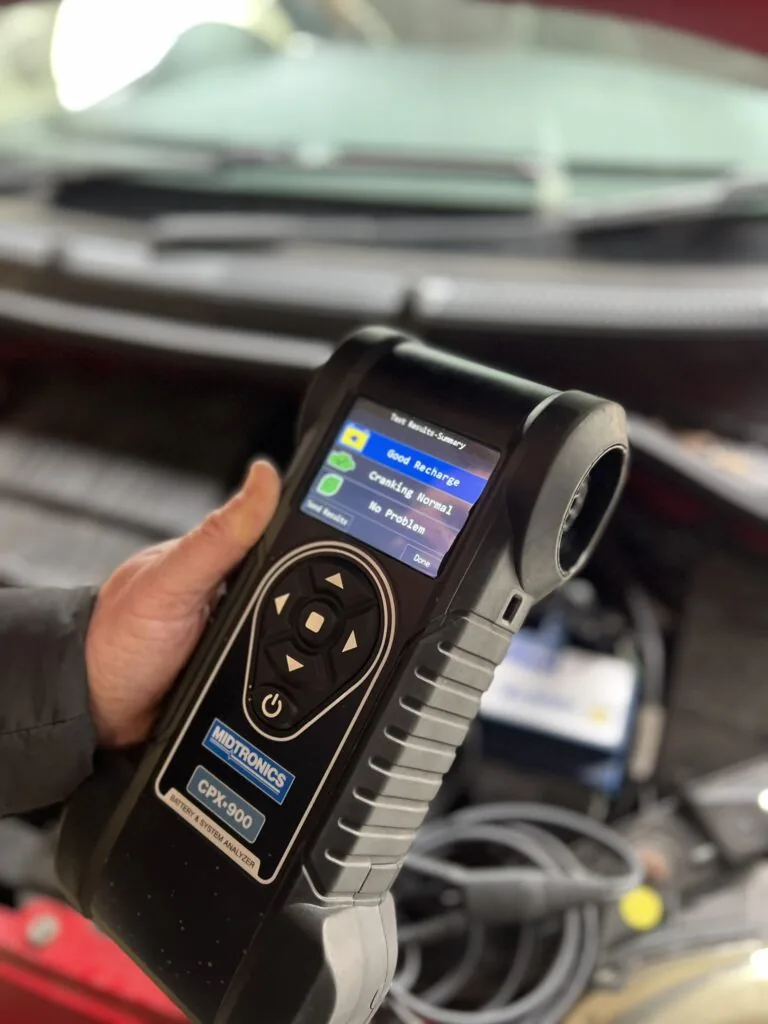
Charge acceptance testing assesses how readily the battery takes charge back in when charging current is applied. Our Midtronics DCA-8000P brings reserve-capacity and charge-acceptance assessments into one diagnostic process.
Read those results separately:
- Reduced capacity means less charge is available to support equipment loads.
- Poor charge acceptance means the battery may struggle to replenish what it uses during the vehicle’s available charging time.
Use both results to guide battery care
We’ll help you use capacity and charge acceptance results to guide charging and replacement decisions.
At Norfolk County Council, for instance, non-starts fell from 40 to two across comparable five-month periods after our battery management programme was introduced. The workshop used recorded test results to guide routine charging and identify batteries needing replacement.
Whether you maintain a fleet, run a fast-fit centre or manage a dealership, ask us about capacity and charge acceptance testing.

