
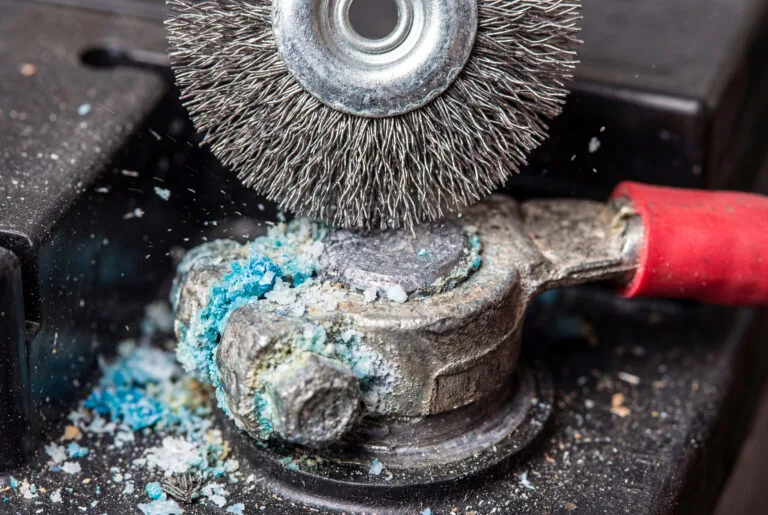
You test a battery and find low cold cranking amps (CCA). You charge it, but the voltage rises too fast. The battery appears full, yet it still won’t support the required load.
You may be dealing with sulphation.
Sulphation affects flooded lead-acid, enhanced flooded battery (EFB), absorbed glass mat (AGM) and gel batteries. It reduces capacity, limits charge acceptance and can lead to early battery failure.
If you catch it in time, you can reverse some sulphation. To do so, you need to identify the problem, use the right charger to recondition it and retest the battery before returning it to service. This blog explains how.
What is battery sulphation?
Sulphation is a build-up of lead sulphate crystals on the battery’s positive and negative plates.
Although we often speak of it as a bad thing, lead sulphate itself isn’t the enemy. It forms as part of the normal discharge process. It’s expected.
When a lead-acid battery discharges, the lead dioxide on the positive plate and sponge lead on the negative plate react with the sulphuric acid electrolyte. Lead sulphate forms on both plates. The electrolyte also becomes more diluted.
Charging (from the onboard charging system, in normal operating circumstances) should reverse this reaction. By sending current back through the battery, the lead sulphate converts back into lead dioxide on the positive plate and sponge lead on the negative plate, while the electrolyte returns towards its charged state.
Sulphation problems really start when the battery sits at a low state of charge (SoC) for an extended period. Without a charging current to reverse the reaction, the lead sulphate stays on the plates. Over time, small deposits grow into larger crystals that become harder to convert during charging.
Technicians often call the early, recoverable stage ‘soft sulphation’. ‘Hard sulphation’ describes the more stable build-up found after a battery has spent too long undercharged. Advanced sulphation may cause permanent loss of capacity.
What causes sulphation?
Anything that leaves a lead-acid battery partially discharged for too long, or repeatedly prevents it from reaching full charge, can contribute to sulphation. Here are some of the most common causes our customers encounter:
- Vehicles making repeated short journeys
- Vehicles standing for long periods without maintenance charging
- Parasitic drain
- A weak alternator or charging-system fault
- Loose, damaged or corroded connections
- Charging voltage that’s too low
- Using a charger or charging profile that doesn’t fully charge the battery
- Repeated deep discharges followed by incomplete recharging
- Stopping charge cycles before they finish
- High electrical demand with too little time to recharge
All lead-acid batteries self-discharge in storage. A vehicle also continues to draw current for alarms, trackers, keyless-entry systems, electronic control units (ECUs) and other equipment.
So, just because a vehicle is parked it doesn’t mean the battery is inactive. Leave it for long enough without charging and its SoC can fall far enough for sulphation to develop.
Heat increases the rate of self-discharge and speeds up many ageing-related reactions. This means a stored battery may need charging more often in warm conditions.
Flooded batteries can also suffer from acid stratification. This happens when the denser acid settles towards the bottom of the cells. Different parts of the plates then work under different conditions. This can promote sulphation towards the bottom of the negative plates and reduce battery performance.
What does sulphation do to a battery?
Lead sulphate crystals cover parts of the active plate material. That leaves less active surface area for the battery’s chemical reactions.
As the build-up increases, you’ll start seeing reduced CCA, lower amp-hour (Ah) capacity, higher internal resistance, poor charge acceptance, slow cranking and reduced stop-start function.
A sulphated battery can also fool you. Its terminal voltage may rise early during charging. A basic charger may read that voltage and reduce its output because it thinks the battery is almost full when, in reality, the battery may have accepted little usable energy.
You may see a similar issue after charging. The open-circuit voltage (OCV) may look reasonable, but the battery still can’t supply the required current or support a load.
As such, voltage alone won’t always tell you whether a battery is suffering from sulphation. How, then, do you identify a sulphated battery?
How can you identify a sulphated battery?
Connect a designated battery tester. A sulphated battery may produce a ‘charge and retest’ result, low measured CCA, poor state of health (SoH) or high internal resistance. However, these results don’t prove sulphation on their own. Plate corrosion, active material loss, a damaged cell and other faults can produce similar readings.
Practically speaking, you identify sulphation by looking at the battery’s history and how it responds to charging and testing. If a battery has spent time undercharged, shows reduced CCA or increased internal resistance and still has poor charge acceptance when you charge it, sulphation is a likely cause.
You can’t confirm sulphation from one tester reading alone, so you also need to rule out other battery and vehicle faults.
Can you reverse battery sulphation?
You can often reverse soft sulphation and recover some lost performance. A compatible smart charger uses a controlled recovery or desulphation stage. Depending on its design, the charger may apply voltage or current pulses before or during the main charging cycle. This helps convert recoverable lead sulphate back into active material.
That said, recovery isn’t guaranteed. It all depends on how long the battery has been left with a low SoC, how deeply it was discharged and the battery’s age, technology and condition. These factors all affect how difficult the sulphation is to reverse.
A recovery mode can’t rebuild corroded grids, replace shed active material or repair a shorted cell. It also can’t save every battery with hard sulphation. Sometimes, it makes more sense to simply replace the battery.
How should you attempt sulphation recovery?
First, identify the battery’s technology, voltage and rated capacity. Check the battery and charger manufacturers’ instructions. Then:
- Inspect the battery for damage.
- Check the electrolyte level if you have a serviceable flooded battery.
- Test the battery and record the result.
- Check for obvious causes of undercharging, including poor connections.
- Deal with any flagged problems you can identify.
- Connect the charger and select the correct profile.
- Run the full charge and recovery programme.
- Allow the battery to cool (if applicable).
- Retest it using the same tester and settings.
- Conduct and record a full system test.
- Confirm the battery can hold charge and support the required load.
Important things to know
Follow the charger’s sequence. Some chargers run their sulphation recovery programme before the main charge. Others require you to charge the battery before selecting a repair mode.
Recovery modes may use a higher voltage than a standard charging profile. This can affect vehicle electronics. Disconnect the battery if the charger manufacturer tells you to, and follow the vehicle manufacturer’s disconnection procedure.
For a standard automotive battery, retest it to see whether the measured CCA and SoH have improved. You may also need to run a capacity test to confirm whether its usable Ah capacity has been restored. A standard conductance test can’t always tell you this.
If the battery still fails after a full recovery cycle, replace it. Don’t keep applying recovery charges in the hope that the next one will work. It’s most likely a waste of time.
You should also avoid DIY treatments. Don’t add chemicals to the electrolyte or connect an unregulated power supply to ‘burn off’ the sulphate. You may damage the battery, the vehicle or yourself.
Should you equalise a sulphated battery?
An equalisation charge is a controlled overcharge. It can help correct acid stratification and some sulphate build-up in certain flooded batteries.
However, you should only equalise a battery when its manufacturer permits it. Equalisation is intended for suitable flooded lead-acid batteries, not as a universal fix for sulphation.
Don’t apply a conventional equalisation charge to an AGM or gel battery. And don’t assume an EFB can take one just because it uses liquid electrolyte. Follow the battery manufacturer’s charging instructions.
Excessive voltage or charging time can cause excessive gassing, water loss, heat, plate corrosion and permanent damage. Use the voltage, current and charging profile specified for the battery.
How can you prevent sulphation?
Preventing sulphation usually costs much less than dealing with it, especially when you multiply the savings across multiple sites or depots.
Test batteries as part of your normal workshop or fleet routine. Record the results in your workshop system, such as ROBIS.
Don’t wait for a no-start. A falling SoC, CCA or SoH gives you time to charge the battery and investigate the cause.
Keep your garaged and low-use vehicles connected to a suitable maintenance charger. A maintenance charger monitors the battery and adjusts its output. This isn’t the same as leaving an old, unregulated trickle charger connected.
Make sure each battery receives a full charge at suitable intervals. Don’t expect a short drive or a few minutes of idling to restore a heavily discharged battery.
Rotronics can help you build sulphation checks into your battery management process. We also supply smart workshop chargers with controlled recovery programmes, including the MPL10.
The earlier you catch an undercharged battery, the better your chances of recovering it before soft sulphation leads to permanent damage.
Get in touch with our team for more information and to source an appropriate reconditioning battery charger.

