
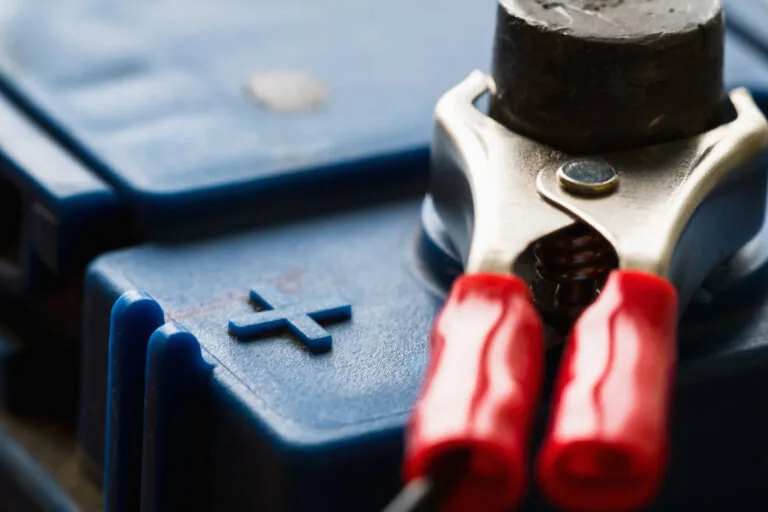
A 12v lead-acid battery and a 12v lithium battery may perform the same job, running your vehicles’ auxiliary systems. However, they don’t accept charge in the same way. This means a lead-acid-only charger can be unsafe to use with a lithium battery unless its charging profile happens to meet the battery manufacturer’s specifications.
This doesn’t apply to all chargers. Many basic units can only support lead-acid batteries. However, others let you select a dedicated lithium charging mode. The most advanced chargers can identify the battery chemistry automatically and choose the correct charging profile for you.
Here’s why you need a specific charger to maintain lithium batteries.
How does lithium charging differ from lead-acid charging?
Many 12v lithium batteries in automotive applications use lithium iron phosphate, or LiFePO4, chemistry. A conventional 12v lead-acid battery contains six cells. Each cell has a nominal voltage of 2v and measures about 2.1v when fully charged and at rest. This gives the battery an open-circuit voltage of around 12.6v. A typical LiFePO4 battery contains four 3.2v nominal cells, giving it a nominal voltage of 12.8v.
A LiFePO4 battery normally works with a battery management system, or BMS. This may be built into the battery or installed separately. It monitors cell voltage and may also monitor current and temperature. If it detects a problem, it can stop the battery from charging or discharging.
The BMS protects the cells, but you shouldn’t rely on it to correct an unsuitable charging profile. The charger must still meet the battery manufacturer’s voltage, current and temperature limits. This is why you shouldn’t assume that a lead-acid-only charger is suitable. You must confirm that its voltage, current and charging stages meet the lithium battery manufacturer’s requirements.
What does a lithium charging mode do?
A dedicated lithium mode follows a charging profile designed for LiFePO4. It changes how the charger responds at each stage of the charging process:
Avoiding lead-acid recovery stages
Lead-acid chargers may use high-voltage desulphation, equalisation or reconditioning stages. These address problems such as sulphation and acid stratification. LiFePO4 batteries don’t experience these lead-acid problems, so a lithium mode skips them altogether.
Protecting the battery at low temperatures
It also handles low temperatures differently. Unlike most modern lead-acid chargers, which increase charging voltage as temperature drops, lithium mode stops charging when the battery falls below its permitted temperature. This is because lithium cells can be damaged or experience lithium plating when charged at low temperatures. Charging is disabled to protect the battery.
Waking the battery after a deep discharge
In a LiFePO4 battery, a deep discharge may cause the BMS to disconnect the battery’s output. The terminal voltage may then be too low for a standard smart charger to detect. If the charger has a lithium wake-up function, it can apply a controlled output to reactivate the charging path. The normal lithium charging profile can then begin.
For example, the CTEK PRO 25S includes a ‘Wake Up’ stage as the first step in its lithium charging mode.
Maintaining the battery after charging
Once the battery is full, lithium mode switches to a suitable maintenance strategy. A lead-acid float stage normally holds a 12v battery at around 13.5v to 13.8v to offset self-discharge and keep it fully charged. A lithium charger, by contrast, may stop charging entirely, restarting only when the voltage falls to a defined threshold, or it may apply a manufacturer-specified maintenance voltage.
Where a maintenance voltage is used, it’s often slightly lower than a traditional lead-acid float level, although the voltage ranges can overlap. The key difference is how the voltage is applied. Lithium systems typically avoid continuous float charging. Instead, they use a stop-and-wait approach, a brief maintenance hold or a restart threshold set around the upper state-of-charge window.
What might happen if you use a lead-acid charger?
The following stages and settings can cause problems:
- Desulphation, equalisation or reconditioning – high-voltage pulses or charging stages might exceed the permitted cell voltage, trip the BMS or damage the cells.
- Absorption and float – excessive voltage or duration can hold the battery at a high state of charge and shorten its life. Settings that are too low may leave it undercharged or prevent the cells from balancing.
- Temperature compensation – some lead-acid chargers increase voltage as the temperature falls. Charging a cold LiFePO4 battery leads to lithium plating and permanent cell damage.
An unsuitable charging profile may repeatedly trip the BMS or leave the battery partly charged. In severe cases, overcharging or internal cell damage can cause swelling, overheating, venting or fire.
For safe, reliable charging, use a charger with a dedicated LiFePO4 mode, automatic LiFePO4 detection or settings expressly approved by the battery manufacturer.
Find a lithium-compatible charger at Rotronics
At Rotronics, we supply lithium-compatible chargers for fast-fit centres, dealerships, workshops and fleets. To get you started, check out the following (more are available):
- CTEK PRO 25SE – a 25-amp workshop charger and power supply with a dedicated LiFePO4 mode.
- MPL50 Li – a 50-amp workshop charger with LiFePO4 support and a contactor-reset mode for deeply discharged lithium batteries.
- Midtronics DCA-8000P – a diagnostic system with automatic 70-amp charging and support for lithium charging.
- ChargeXpress PRO 100-2 – a twin-output charger for 12v and 24v systems. It can charge two 12v batteries at the same time, making it suitable for fleet workshops.
- CTEK PRO 120 – a high-current charger and 120-amp power supply for charging, diagnostics and vehicle programming.
All our Midtronics and CTEK units come with a two-year warranty. You’ll also have access to our technical team, product training, ongoing support and UK service centre.
Tell us which batteries you maintain, their capacities and how you’ll use the charger. Get in touch with Rotronics, and we’ll help you choose the right lithium charging solution.

