
Battery balancing affects battery life in 24-volt systems because it changes how evenly the two 12-volt batteries respond to load and charge. In your fleet workshop, one weak or mismatched battery effectively limits the performance of the other. It can shorten service life, reduce cranking performance and increase the risk of vehicle downtime.
As a fleet manager, technician or workshop team, battery balancing, when done properly, can help reduce replacement costs, cut VOR time, improve first-time starts, support better maintenance planning and give you more confidence in your test results. In turn, that helps your workshop make better calls, avoid unnecessary battery swaps and reduce battery-related failures across your fleet.
On this page, we walk you through the impact of battery balancing on your fleet’s batteries, and why it’s so important to carry out proper battery balancing.
What is battery balancing?
Battery balancing means keeping batteries in a set at a similar state of charge (SoC) and condition. Each battery should charge and discharge evenly, so one weak battery doesn’t limit the performance of the other.
When two 12V batteries are connected in series to create a 24V system, they need to perform as a matched pair. If one battery is weaker, lower in capacity or at a lower state of charge, it reaches its limits sooner. The vehicle then has less usable capacity from the full set, even if the other battery still has more to give. For a deeper explanation of why this happens, read our guide on why vehicle batteries drop out of balance.
During charging, the two batteries still receive the same charge current, but they may not accept that charge evenly. The alternator or charging system can’t send one amount of current to one battery and a different amount to the other. This means one battery remains undercharged, while the other may be pushed harder than it needs to be.
Over time, that imbalance increases the risk of sulphation in the undercharged battery, overcharge stress in the stronger battery, heat build-up, reduced cranking performance and premature failure of the battery pair. Basically, your fleet’s buses, lorries, vans, coaches, agricultural machinery, construction equipment, plant equipment, emergency vehicles and other heavy-duty vehicles become less reliable.
How imbalance shortens battery life
Battery imbalance shortens 24-volt battery life by causing:
- Uneven performance under load – one battery reaches its limits sooner, reducing the usable performance of the combined pair.
- Low state of charge – a weak battery never reaches a healthy SoC.
- Overcharge stress – the stronger battery may experience excess heat, and subsequent issues, from overcharging.
- Reduced usable capacity – the battery set can only perform as well as the weakest unit.
- Sulphation risk – batteries left undercharged for too long lose capacity faster.
- Extra heat and strain – imbalance increases stress during charge and discharge cycles.
- Early battery failure – the two 12V batteries should be replaced as a pair. Imbalance means you need to do this much sooner.
- Repeat costs – replacing the batteries without fixing the imbalance could lead to repeat failures.
Why battery balancing is so important for fleets
Battery balancing improves your fleet’s efficiency, but it’s about so much more than just the price of the battery. The bigger risk to your fleet isn’t the money you spend on a new battery. It’s the risk of a non-start.
That suddenly means a delayed vehicle, a disrupted route, recovery costs, re-organised services, a sudden rush to fix the problem, less time for planned workshop tasks, reputational damage, drivers and crews unable to work, and more.
It’s one thing when these non-starts or slow cranks happen in the yard at the start of the day. It’s another altogether when they happen 50 miles away, blocking a road and leaving your drivers, passengers or customers wondering what to do next.
All that is just a small part of why you should treat battery balancing as a vehicle uptime issue.
Better battery data means better workshop decisions
Battery balancing also helps your fleet teams control their maintenance costs. Without proper testing, your workshop might instinctively replace batteries too early. Or it may replace only one battery in a set. Or it may miss the root cause of a repeat failure. With better battery data, your technicians can make better decisions about then to charge, rebalance, replace or carry out a more in-depth investigation.
When you take the time to balance your batteries, they’re much more likely to work as a pair. And if you do notice any problems developing during the balancing process, you can fix them.
Heavy electrical loads make battery imbalance worse
This is especially important if your fleet operates commercial vehicles with extra heavy electrical loads, such as those fitted with tail lifts, refrigeration units, lighting, telematics and safety systems. Constant idling and short runs between engine starts make the impact even worse, as the charging system doesn’t have time to replenish the batteries.
How to test the batteries in your 24-volt fleet vehicle
Battery balancing is, in effect, fairly simple. The aim is to understand whether the batteries in a 24V pair are still close enough in condition to work properly as a set:
- In most cases, isolate the batteries.
- Use a professional battery tester to test each 12V battery individually.
- Check cranking performance, state of charge, state of health, reserve capacity and charge acceptance.
- Compare the results. A small difference is normal, but a large gap can point to imbalance, ageing or a failing battery.
- Use a trusted battery charger to recharge, recover or recondition suitable batteries.
- Re-test the batteries after charging to confirm whether they’re close enough in condition to work as a matched pair.
- Upload the test results to ROBIS, or save them somewhere useful for future analysis.
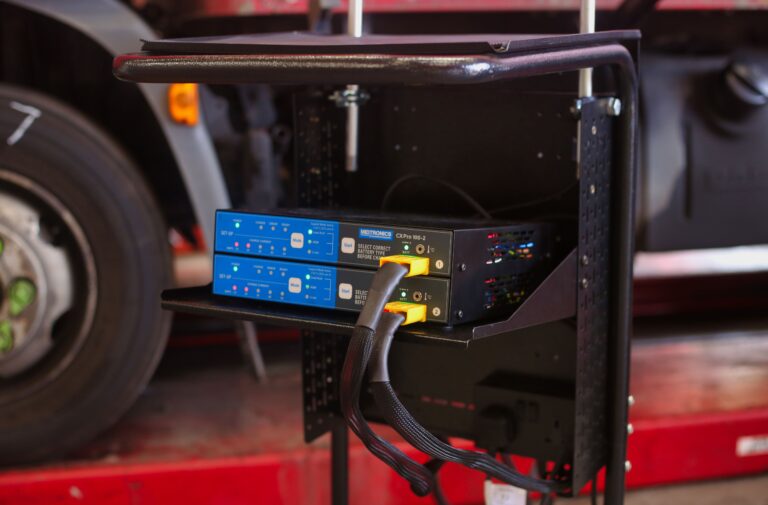
Rotronics supplies professional 24-volt battery balancing, testing and diagnostic equipment, including twin-output chargers such as the Midtronics ChargeXpress PRO 100-2 for 24V battery set maintenance, alongside ROBIS-connected tools such as the CPX-900 ROBIS for advanced 12V diagnostics and fleet battery data.
Signs your fleet may have battery imbalance problems
Here are some of the most common signs of battery imbalance in your fleet. If you notice any of these repeatedly, remove the batteries from the vehicle and test them:
Vehicles need repeated jump-starts
The batteries may not be holding charge or delivering enough cranking amps. Watch for this happening across similar vehicles or routes. Jump-starting gets the vehicle moving, of course, but it doesn’t fix the fault. Without proper testing, the same vehicle may come back every week with the same no-start issue.
Problems are worse in cold weather
Cold starts quickly expose weak battery sets. Your vehicles might start just fine in warmer weather and then struggle when the temperatures drop. That’s because of the greater cranking demand. So, if certain 24V fleet vehicles become unreliable in winter, investigate battery balancing before replacing units.
One battery fails before the other
If a technician notices that one battery in a 24V pair keeps failing before the other, it may be a sign of imbalance. The underlying cause could be a mismatch in age, condition, capacity, state of charge, internal resistance or charge acceptance.
It’s not always as simple as the ‘weaker’ battery failing first. One battery may become weaker than the other, but the combined set loses usable performance, and either battery could suffer premature failure. Again, testing, charging and rebalancing the batteries may help if both units are still serviceable.
Test results vary between batteries in the same pair
If you notice a significant difference between test results for two batteries in the same 24V system, that’s a red flag. This may show that one battery is deteriorating faster, accepting charge differently, or reaching its limits sooner. It may appear as different test results, different states of charge, different cranking performance or different reserve capacity readings.
Battery life is shorter than expected
A short battery life alone doesn’t necessarily mean a serious imbalance problem. You could have a weak charging system, parasitic drain, poor maintenance, battery imbalance or any number of other potential issues. This is where having fleet data helps. If one route, depot, vehicle type, or duty cycle keeps killing your batteries, look for the pattern. Our ROBIS software can help you keep track of all your fleet test results.
New batteries fail soon after being paired with older batteries
We don’t recommend replacing only one of the batteries in the system. This immediately introduces a mismatch, even if they’re the same make and model. Even though it feels cheaper upfront, the imbalance can reduce the life of the replacement battery, leading to another failure sooner than expected.
Certain vehicles or depots have repeat failures
If the same vehicle type, route or depot keeps producing battery faults, look beyond the individual battery. Of course, repeat failures could point to all sorts of things. But one possible cause may be a lack of proper battery balancing processes.
Does battery balancing really extend fleet battery life?
Yes, battery balancing can extend battery life when imbalance is causing extra battery stress. Balanced batteries share the electrical load more evenly. That helps reduce strain on each battery in the pair.
But balancing alone certainly isn’t a magic fix. If a battery is already damaged, heavily sulphated, physically degraded or unable to hold charge, you’ll still need to replace it. And always replace the two batteries together to avoid further complications.
The real value for your fleet comes from implementing good battery balancing routines as part of your comprehensive battery maintenance schedule. This includes regular battery testing (and charging, if applicable), replacement when necessary, system testing and the storage and analysis of your fleet battery data. With this approach, you can make a data-based decision on the best thing to do next.
Get better battery insight with Rotronics
Battery balancing starts with knowing what’s really happening. With the right testing equipment, your workshop can identify weak batteries, compare 12V units in a 24V system, reduce repeat failures and make better replacement decisions.
Rotronics supplies professional battery testing, charging and diagnostic equipment for fleet workshops, commercial vehicles, and heavy-duty battery maintenance. Get in touch with our team to find the right tools for your workshop, or learn more about ROBIS here.

